
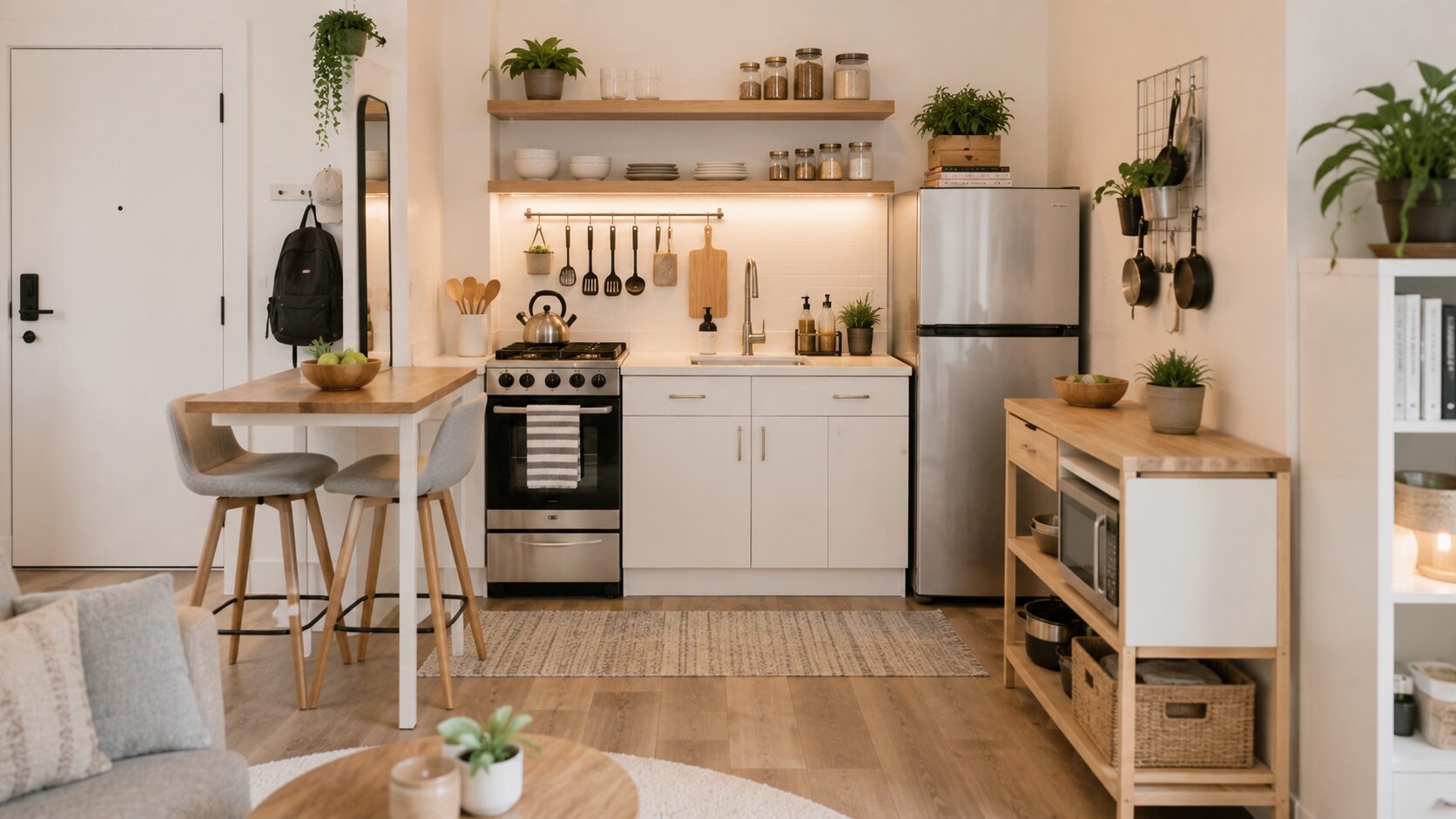
Small Studio Apartment Kitchen Ideas – Cooking Well in a Tiny Footprint
A studio apartment kitchen is usually an afterthought in the floor plan — a stretch of counter along one wall, a compact fridge, maybe a two-burner stove, and just enough cabinet space to hold the basics. It’s rarely designed with real cooking in mind, and yet it’s expected to handle everything from morning coffee to dinner for guests.
That gap between what the kitchen offers and what it needs to do is the central challenge of studio kitchen design. And it’s a genuinely solvable one — not by pretending the space is bigger than it is, but by being deliberate about every inch of storage, every piece of equipment, and every workflow decision.
The studio kitchens that function well share a few things in common: they use vertical space aggressively, they store fewer but more versatile tools, and they’re organized around how the person actually cooks rather than how a full-sized kitchen is conventionally laid out. None of this requires a renovation. Most of it is entirely achievable with organization, a handful of well-chosen additions, and some honest editing of what’s currently taking up space.
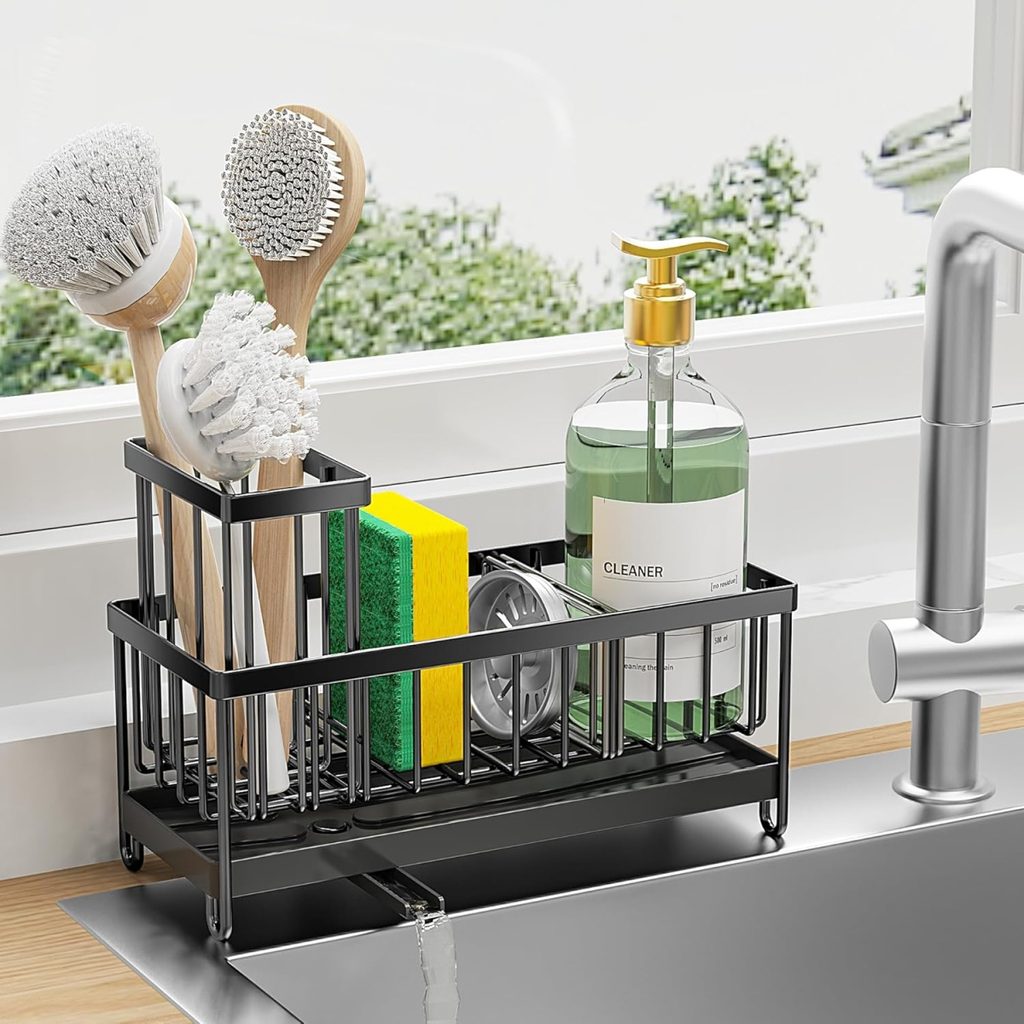
Cisily Sponge Holder for Kitchen
Kitchen Countertop Organizers and Storage Essentials, Rustproof 304 Stainless Steel
This guide covers small studio apartment kitchen ideas across storage, layout, equipment, and daily workflow — practical solutions for making a genuinely tiny kitchen work as hard as it needs to.
Understanding the Studio Kitchen’s Real Constraints
Before the specific ideas, it helps to name exactly what makes a studio kitchen different from a small kitchen in a house or a one-bedroom apartment.
Most studio kitchens have some combination of these limitations: a single run of counter (often under 6 feet total, sometimes much less), a compact or mini fridge rather than a full-size one, two burners instead of four, frequently no full oven — a countertop convection or toaster oven substitutes — and minimal upper and lower cabinet space, sometimes just two or three cabinets total.
These aren’t universal — some studios have surprisingly complete kitchenettes — but the ideas in this guide are built around the more constrained end of that range, because solutions that work for the tightest studio kitchens scale up easily to slightly more generous ones, while the reverse isn’t always true.
Small Studio Apartment Kitchen Storage Maximizing
Claim the Wall Space First
In a studio kitchen, wall space above the counter and below the upper cabinets (or above them, if there’s a gap to the ceiling) is almost always underused. This is the first place to look for additional storage before considering anything that requires new furniture.
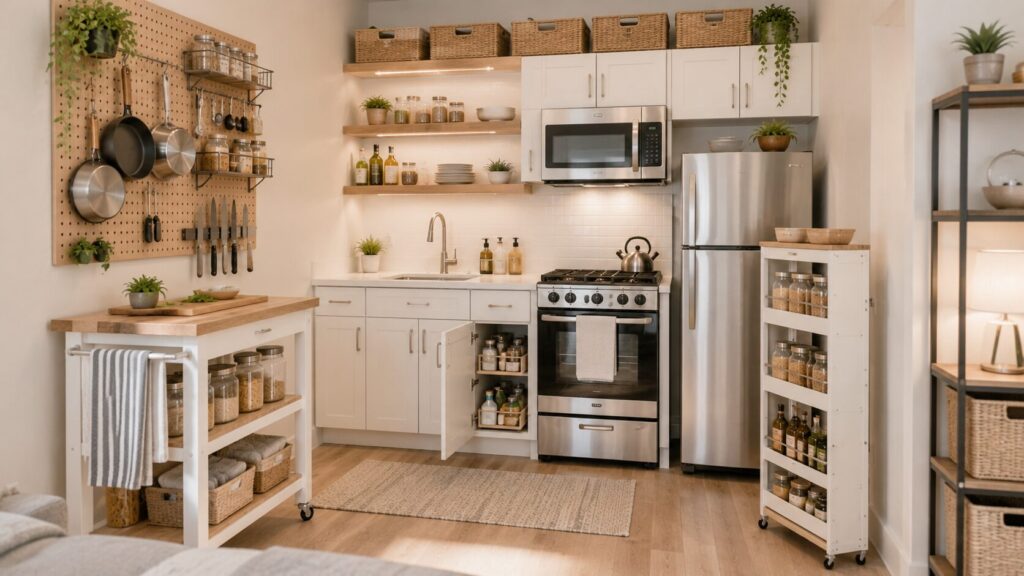
A pegboard panel mounted on any open wall space near the cooking area holds pots, pans, utensils, and even some dry goods in jars with the right hook and shelf attachments. It’s fully reconfigurable, which matters in a kitchen where storage needs shift as your cooking habits evolve.
Magnetic strips for knives free up drawer space that’s often at a premium and keep blades more accessible than digging through a drawer.
Floating shelves above the counter — even a single 24-inch shelf — hold spices, oils, and frequently used items that would otherwise compete for cabinet space. Two or three shelves stacked with 8–10 inches between them handle a meaningful amount of storage in a footprint of just a few square feet of wall.
The gap above upper cabinets, if there is one, is frequently wasted. Baskets or labeled bins on this shelf hold items used only occasionally — specialty bakeware, large serving dishes, extra small appliances — keeping them accessible without occupying prime, easy-reach storage.
Make Every Cabinet Work Harder
Stackable, uniform containers for dry goods (rice, pasta, flour, cereal) fit more efficiently into a small cabinet than the mismatched original packaging, which wastes space through irregular shapes and half-empty boxes.
Cabinet door organizers — small adhesive-mounted racks on the inside of cabinet doors — hold spice jars, small bottles, or cleaning supplies in space that’s otherwise completely unused. This alone can meaningfully increase a small kitchen’s effective storage capacity without adding a single new piece of furniture.
Stacking shelves inside cabinets double the usable vertical space within a single cabinet by creating two tiers rather than one deep, disorganized pile. These are inexpensive (typically $10–$20 per shelf) and make items in the back of a cabinet visible and reachable rather than lost.
A lazy Susan in any corner cabinet or on a shelf holding condiments and oils makes items in the back accessible with a spin rather than requiring everything in front to be removed first.
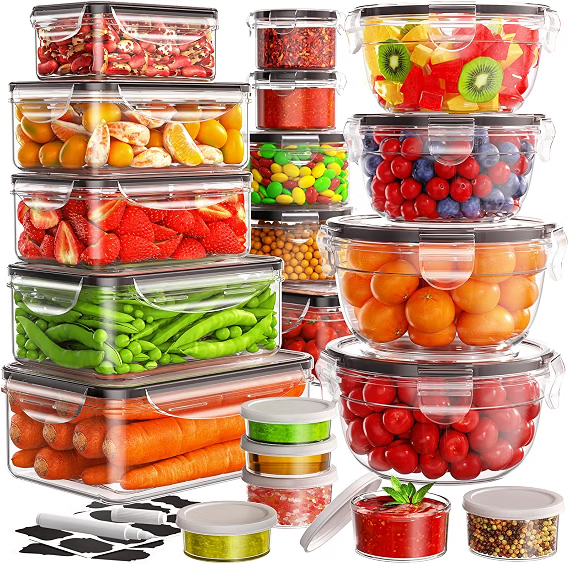
40 PCS Food Storage Containers with Lids Airtight
Kitchen Countertop Organizers and Storage Essentials, Rustproof 304 Stainless Steel
Rolling and Mobile Storage
A slim rolling kitchen cart is one of the single most valuable additions to a studio kitchen. It adds counter space, storage (often with drawers or shelves), and can be positioned right at the cooking area during meal prep, then rolled against a wall or into a corner the rest of the time. This flexibility — extra function only when needed — matters enormously in a space with no room for permanent expansion.
A narrow rolling pantry (tall, slim, on wheels) tucks into the gap beside a fridge or at the end of a counter run, holding significantly more dry goods and canned items than open shelf space alone would allow, while remaining fully mobile if the kitchen layout ever needs to change.
Small Studio Kitchen Layout and Workflow
Organize by Zone, Even in a Tiny Footprint
Even a kitchen with just a few feet of counter benefits from thinking in zones — a prep zone, a cooking zone, and a cleanup zone — rather than treating the space as one undifferentiated stretch of counter.
The prep zone (near the fridge, ideally) is where cutting boards, knives, and mixing bowls live, positioned close to where ingredients come out of storage.
The cooking zone (around the stovetop) holds pots, pans, cooking utensils, and oils — everything needed within arm’s reach of active cooking.
The cleanup zone (near the sink) holds dish soap, sponges, and a small drying rack, kept separate from the prep and cooking zones so dirty dishes don’t compete for space with active food prep.
In a genuinely tiny kitchen, these zones might overlap or be inches apart rather than feet — but even loosely defining them, and storing items accordingly, reduces the amount of back-and-forth movement required to cook a meal.
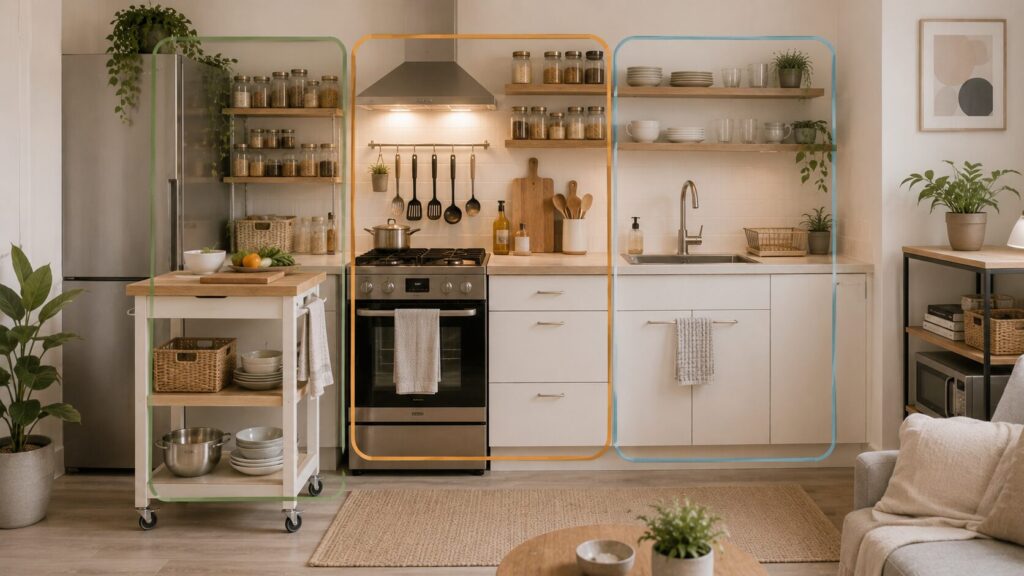
The Rolling Cart as a Mobile Prep Station
If counter space is severely limited — under 3 feet total, which does happen in some studio kitchens — a rolling cart functionally becomes the prep zone. Position it beside the existing counter during cooking to extend the usable surface, then roll it away afterward. This single piece of furniture can solve the single biggest workflow problem a tiny kitchen presents: not having enough flat surface to actually prepare food.
Keep the Counter Clear by Default
The habit that matters most for a studio kitchen’s daily function: returning appliances and tools to their storage spot after use rather than leaving them on the counter “for next time.” In a kitchen with minimal counter space, even one or two items left out permanently can meaningfully reduce the usable prep area. This isn’t a decorating tip — it’s a functional necessity specific to how little surface area studio kitchens actually offer.
Equipment Choices for a Small Studio Apartment Kitchen
Choose Multi-Function Appliances Over Single-Purpose Ones
Counter space in a studio kitchen is too valuable to dedicate to appliances that do only one thing, especially if that thing is used infrequently.
A multi-function pressure cooker/slow cooker/rice cooker combo appliance replaces what would otherwise be three or four separate devices, at a fraction of the combined counter footprint. These have become widely available and genuinely capable across all their functions, not just a compromise version of each.
A toaster oven with air fryer and convection functions handles baking, roasting, reheating, and air frying in one compact unit — often substituting for a full oven entirely in kitchens that don’t have one, while also replacing a separate air fryer and toaster.
An immersion blender instead of a full countertop blender, where feasible, takes up a fraction of the storage space and handles soups, sauces, and smoothies for most everyday needs. A full blender is worth keeping if smoothies or ice-heavy drinks are a regular habit, but for occasional use, an immersion blender is the more space-efficient choice.
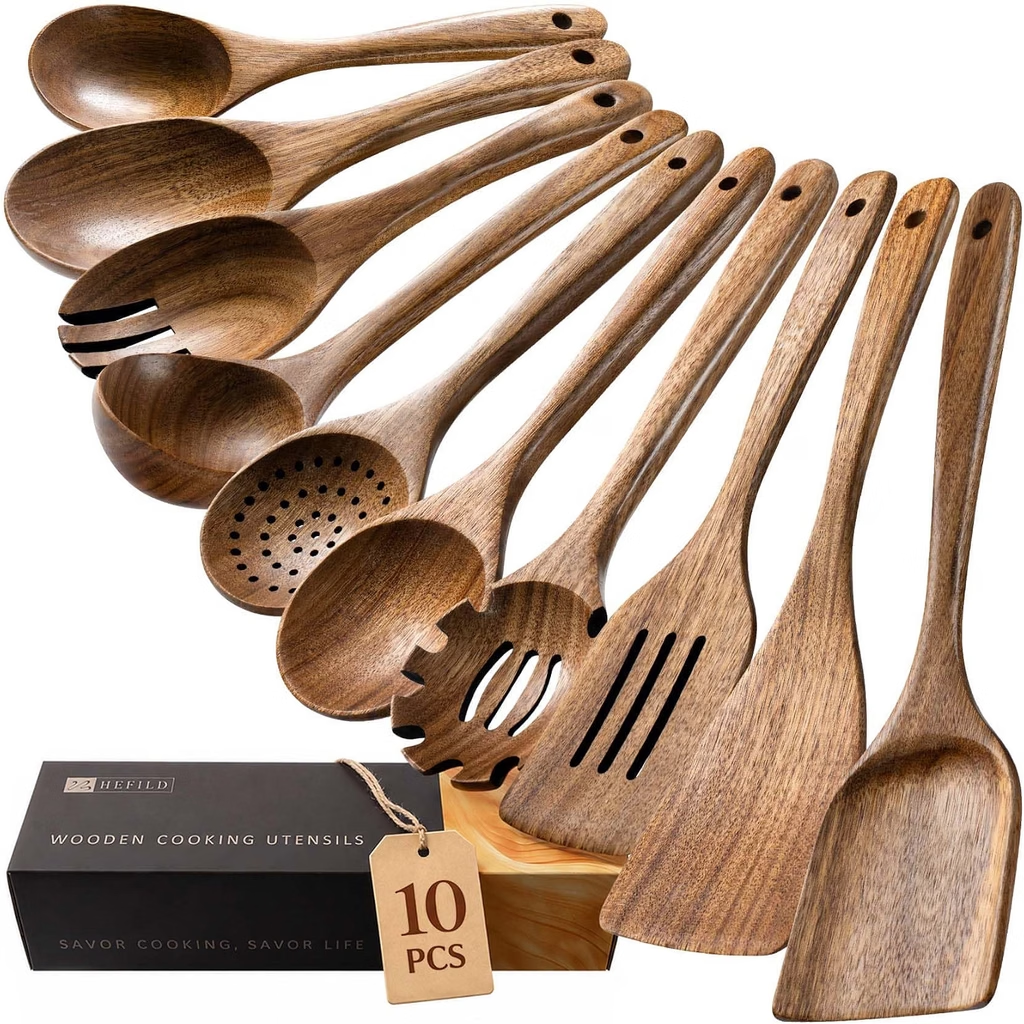
10 Pieces Wooden Spoons For Cooking
Spoons and spatulas stir, mix, flip and serve; balanced handles offer control while staying gentle on nonstick cookware.
Cookware: Fewer, Better Pieces
A compact kitchen benefits from a curated set of cookware rather than an accumulated collection of pots and pans in every size.
A practical minimal set: one 10–12 inch skillet (nonstick or well-seasoned cast iron), one medium saucepan with a lid, one larger pot for pasta or soup, and one sheet pan if a toaster oven or full oven is available. This handles the overwhelming majority of everyday cooking needs without the storage burden of a full 10-piece cookware set, most of which goes unused in any kitchen, small or large.
Nesting cookware sets, designed specifically to stack inside each other with detachable or shared handles, are worth the investment in a studio kitchen — they take up meaningfully less cabinet space than standard cookware sets with each piece stored separately.
Dishware: Right-Sized for the Space and the Household
A full 12-piece dish set (four each of plates, bowls, mugs) is often more than a solo studio dweller needs and takes up cabinet space that could serve other purposes. A smaller set — four plates, four bowls, four mugs, or even fewer for a single-person household — reduces storage demand directly.
Stackable, uniform dishware (matching sets rather than mismatched pieces of different shapes and sizes) stores more efficiently in a small cabinet than a collection of differently sized items that don’t nest together cleanly.
Making a Small Studio Kitchen Look (and Feel) Better
Under-Cabinet Lighting
Many studio kitchens have no dedicated task lighting over the counter, which leaves the prep area in shadow when the overhead light is the only source. Plug-in or battery-operated LED strip lights mounted under the upper cabinets solve this without any wiring — install time is under 20 minutes, and the impact on both function and atmosphere is significant.
A Consistent, Light Color Palette
Where you have any control over the kitchen’s finishes — a backsplash, open shelving, or even just what’s displayed — a light, consistent palette makes the compact space feel less closed in. This matters more in a studio kitchen than a house kitchen because the kitchen is visible from the rest of the apartment at all times; a visually heavy or cluttered kitchen affects how the whole studio feels, not just the cooking area.
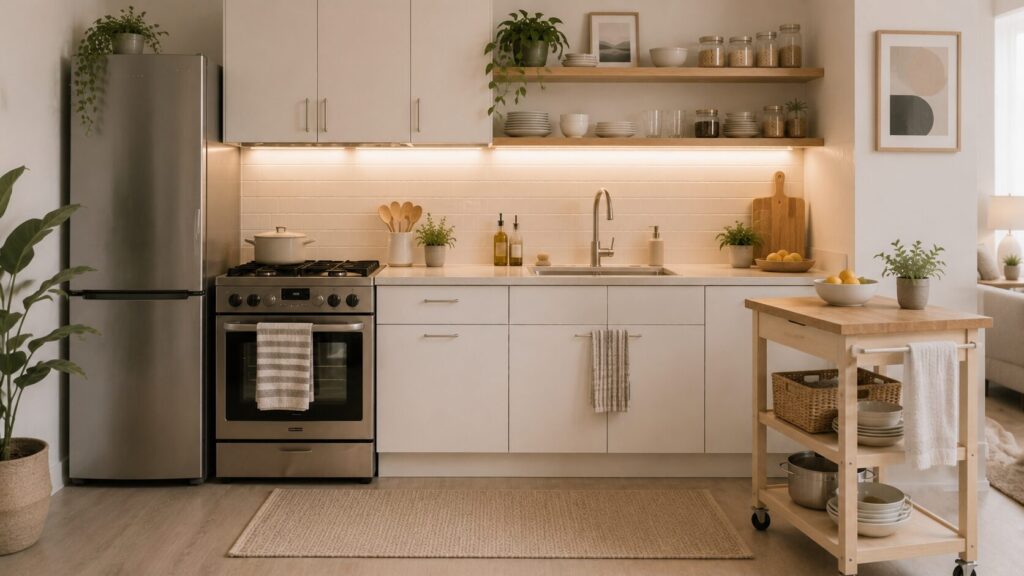
A Small Rug or Mat at the Cooking Zone
A slim, low-profile kitchen mat in front of the stove and sink adds comfort underfoot during meal prep and introduces a small design element to a space that’s otherwise entirely functional surfaces. Choose a low-pile, easy-to-clean option given the kitchen’s proximity to spills and splatters.
Open Shelving, Used Selectively
Full open shelving throughout a small kitchen can look cluttered fast, but one section of open shelving — holding a curated set of dishware, a few glass jars of dry goods, and one or two plants or decorative objects — adds visual interest and a sense of intentional design to what’s otherwise a purely utilitarian space. The key, as with open shelving anywhere, is restraint: fewer, well-chosen items rather than everything the kitchen owns on display.
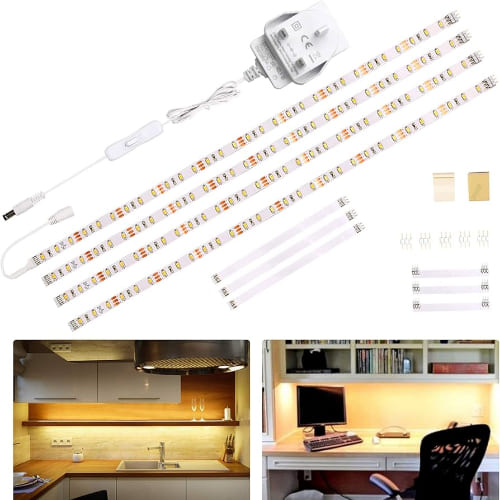
Wobane Under Cabinet Lighting Kit (Flexible LED Strip Lights)
This kit delivers a strong, evenly distributed glow under cabinets or shelves, combining flexibility and ease of installation to brighten kitchens, closets, or workspaces.
Small Studio Apartment Kitchen Ideas for Renters Specifically
Removable and Reversible Upgrades
For renters, the priority is upgrades that improve the kitchen’s function and look without requiring permanent changes.
Peel-and-stick backsplash tile transforms a plain or dated wall behind the counter for $30–$80 in materials and comes off cleanly at move-out.
Adhesive-mounted organizers (magnetic strips, small shelves, cabinet door racks) install with strong mounting tape rather than screws, holding securely for daily use while leaving no permanent damage when removed.
New cabinet hardware, with the originals stored for reinstallation, remains one of the highest-impact, lowest-cost kitchen upgrades available to renters — covered in more depth in other guides but worth repeating here specifically for studio kitchens, where the compact cabinet run means even a small number of new pulls (often just 4–8 pieces total) makes a proportionally large visual difference.
Freestanding Solutions Over Built-In Ones
Since renters generally can’t add built-in cabinetry or expand counter space permanently, freestanding pieces — the rolling cart, the slim rolling pantry, a small standalone shelving unit — deliver most of the same functional benefit while remaining fully portable for the next move.
Quick Reference: Small Studio Apartment Kitchen Ideas by Category
Storage:
- Pegboard, magnetic strips, and floating shelves for wall space
- Stackable containers and cabinet door organizers for existing cabinets
- Rolling cart and slim rolling pantry for mobile, flexible storage
- Lazy Susan for corner cabinets or condiment organization
Layout and workflow:
- Define prep, cooking, and cleanup zones even in a tiny footprint
- Use a rolling cart as a mobile prep station if counter space is under 3 feet
- Keep the counter clear by default — return items to storage after each use
Equipment:
- Multi-function appliances (pressure/slow/rice cooker combo, toaster oven with air fry)
- A curated cookware set: one skillet, one saucepan, one larger pot, one sheet pan
- Nesting cookware and right-sized, stackable dishware for the household size
Design and atmosphere:
- Under-cabinet LED lighting (plug-in or battery, no wiring needed)
- Light, consistent color palette visible from the rest of the studio
- Selective open shelving with a curated, restrained display
Renter-specific:
- Peel-and-stick backsplash for a reversible visual upgrade
- Adhesive-mounted organizers instead of screwed-in fixtures
- New cabinet hardware with originals stored for move-out
- Freestanding rather than built-in storage solutions
Conclusion
Small studio apartment kitchen ideas work best when they accept the kitchen’s real constraints rather than trying to force full-kitchen expectations onto a fraction of the space. A studio kitchen with a few feet of counter, a mini fridge, and two burners can still support real, satisfying cooking — it just requires more deliberate choices about storage, equipment, and workflow than a full-sized kitchen ever demands.
Vertical storage does the most work of any single strategy here — claiming wall space with pegboards, shelves, and magnetic strips recovers capacity that a tiny kitchen doesn’t have on the counter or in cabinets. Multi-function appliances and a curated, right-sized set of cookware reduce the volume of equipment competing for that limited storage in the first place. And treating even a few feet of counter as distinct zones — prep, cooking, cleanup — keeps the workflow efficient regardless of how little physical space separates those functions.
None of this requires a kitchen renovation, and most of it is entirely renter-friendly. Start with the wall space, since it’s the most under-used resource in almost every studio kitchen. Add a rolling cart if counter space is genuinely tight. Then edit down to the cookware and appliances you actually use regularly, rather than everything that happened to come with you from a larger kitchen.
A studio kitchen designed this way doesn’t feel like a compromise. It feels like a kitchen that’s been thought through completely — and that’s exactly what makes it work.
Frequently asked question:
How do I get more storage in a tiny studio kitchen?
Vertical wall space is the biggest untapped storage resource in most studio kitchens. A pegboard panel for pots, pans, and utensils, floating shelves for spices and frequently used items, and magnetic strips for knives all add meaningful storage without requiring any new furniture. Inside existing cabinets, stacking shelves double the usable vertical space, and cabinet door organizers use the completely wasted space on the inside of cabinet doors. A rolling kitchen cart or slim rolling pantry adds mobile storage and counter space that can be positioned exactly where needed and moved out of the way otherwise — genuinely one of the highest-value single additions for a tight studio kitchen.
Can you cook real meals in a studio apartment kitchen with only two burners and no oven?
Yes, with some adaptation. Two burners handle the majority of everyday cooking — sautéing, boiling, simmering, one-pot meals — and a quality toaster oven with convection and air fry functions covers most of what a full oven would otherwise handle: roasting vegetables, baking, reheating, and air frying. Multi-function appliances like a combined pressure cooker/slow cooker/rice cooker further expand what’s possible without needing separate devices or additional burners. The main adjustment is planning meals around one-pot or sequential cooking rather than multiple dishes requiring simultaneous stovetop and oven use — which is more a shift in cooking approach than a real limitation on what can be prepared.
What kitchen appliances are worth the counter space in a small studio?
Prioritize multi-function appliances that replace two or three single-purpose devices. A combined pressure cooker/slow cooker/rice cooker handles a wide range of cooking methods in one footprint. A toaster oven with air fryer and convection settings often substitutes for a full oven, a standalone air fryer, and a toaster simultaneously. An immersion blender, for those who don’t need a full countertop blender daily, takes up a fraction of the storage space of a standard blender while handling soups, sauces, and most smoothie needs. Beyond these, a coffee maker and a basic electric kettle round out what most studio kitchens genuinely need — additional single-purpose gadgets are usually better left out given the storage cost relative to how often they’re actually used.
How do I organize a small studio kitchen with minimal cabinet space?
Start by reducing what needs to be stored — a curated cookware set (one skillet, one saucepan, one larger pot, one sheet pan) and a right-sized dish set for your household handle most needs without the volume a full collection requires. From there, use stackable, uniform containers for dry goods rather than original packaging, which wastes space through irregular shapes. Add stacking shelves inside cabinets to create two tiers instead of one, and use the inside of cabinet doors for small adhesive-mounted racks holding spices or cleaning supplies. A lazy Susan in any corner cabinet makes items in the back accessible without unpacking everything in front of them.
How can renters upgrade a studio kitchen without making permanent changes?
Several options genuinely improve a rental kitchen’s function and look while remaining fully reversible. Peel-and-stick backsplash tile updates a plain wall for $30–$80 and removes cleanly at move-out. New cabinet hardware, with the original pulls stored for reinstallation, is one of the highest-impact low-cost upgrades available — especially valuable in a studio kitchen’s compact cabinet run, where even a small number of new pulls makes a proportionally large difference. Adhesive-mounted organizers (magnetic strips, small shelves, cabinet door racks) install with strong mounting tape instead of screws. And freestanding pieces — a rolling cart, a slim rolling pantry, a small shelving unit — provide most of the functional benefit of built-in storage while remaining fully portable for the next move.