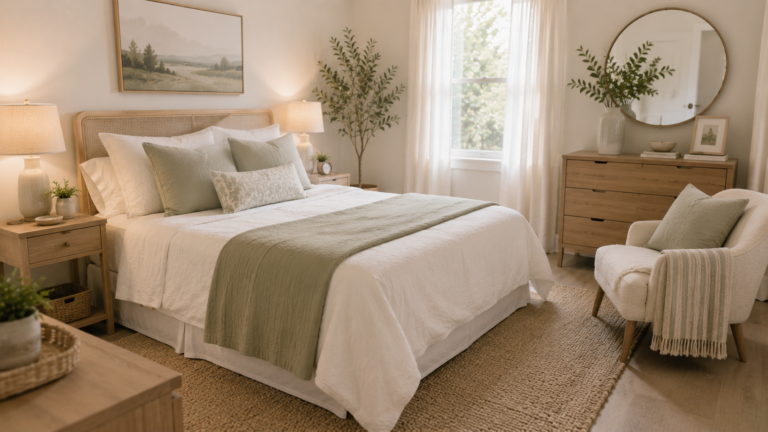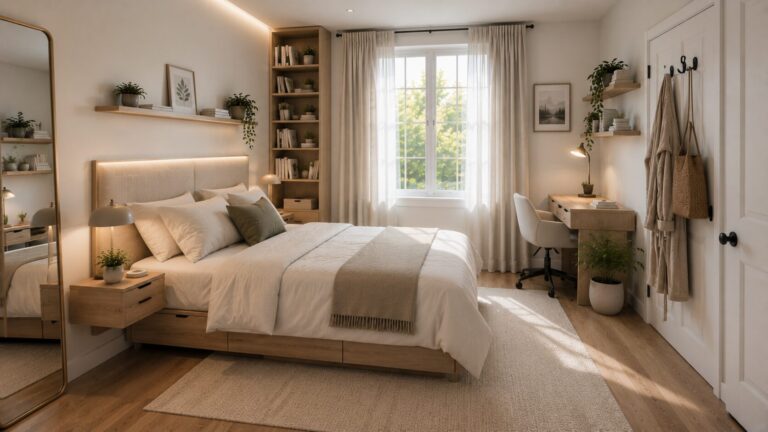
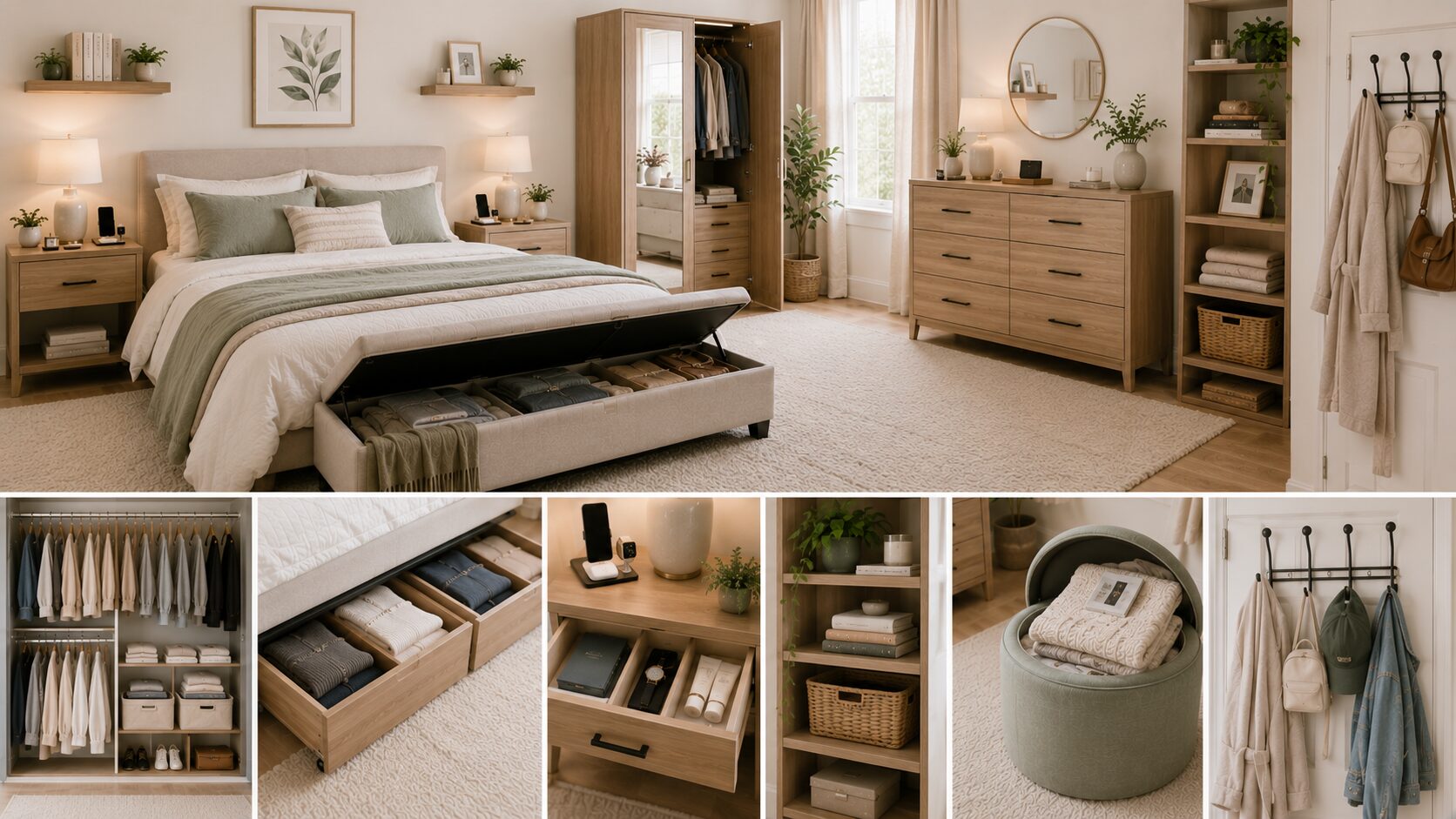
Small Bedroom Storage Ideas for Couples
One person’s small bedroom is a tight but manageable space. Two people’s small bedroom is a completely different problem.
You’ve got double the clothes, double the shoes, double the skincare products, double the “I don’t know where else to put this” stuff — and the same number of square feet to put it all in. The floor gets claimed first. Then every flat surface. Then the chair in the corner becomes a laundry staging area that never quite clears.
It’s not a discipline problem. It’s a storage design problem. And storage design problems have solutions.
The difference between a small bedroom that works for two people and one that feels perpetually chaotic usually comes down to three things: how well the space uses its vertical square footage, how clearly each person’s belongings have a defined home, and how much multi-functional thinking went into the furniture choices.
This guide covers the best small bedroom storage ideas for couples — practical, specific strategies that give both people enough room for their things without requiring a renovation or a larger apartment. Whether you’re dealing with 100 square feet or 150, whether you have a walk-in closet or a single reach-in, there’s a workable system here.
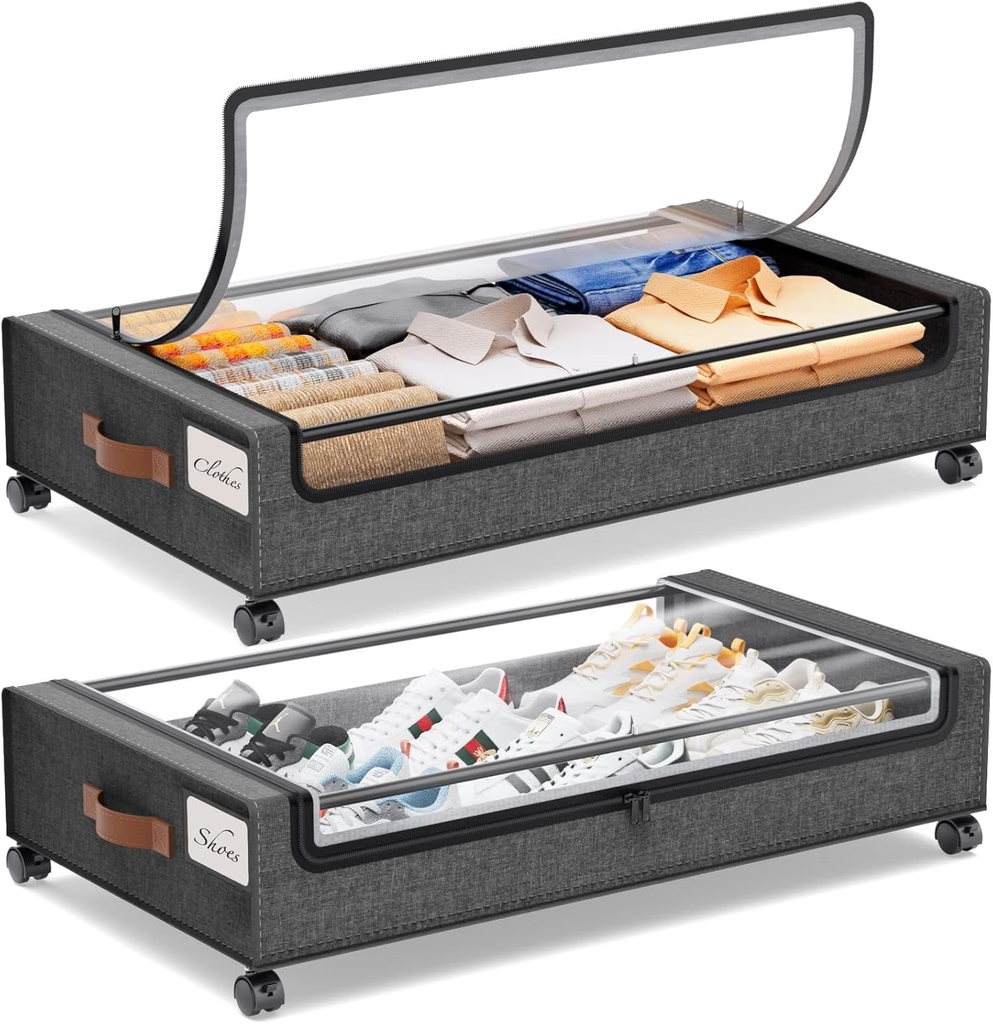
Yecaye Under Bed Storage with Wheels
Pack of 2 Under Bed Storage organizers for shoes, clothes, blankets etc.
Start With the Real Problem: Double the Stuff, Same Space
Before any storage solution makes sense, it helps to be honest about what you’re actually dealing with.
Two people sharing a bedroom brings a specific set of challenges that single-occupant bedroom guides don’t address:
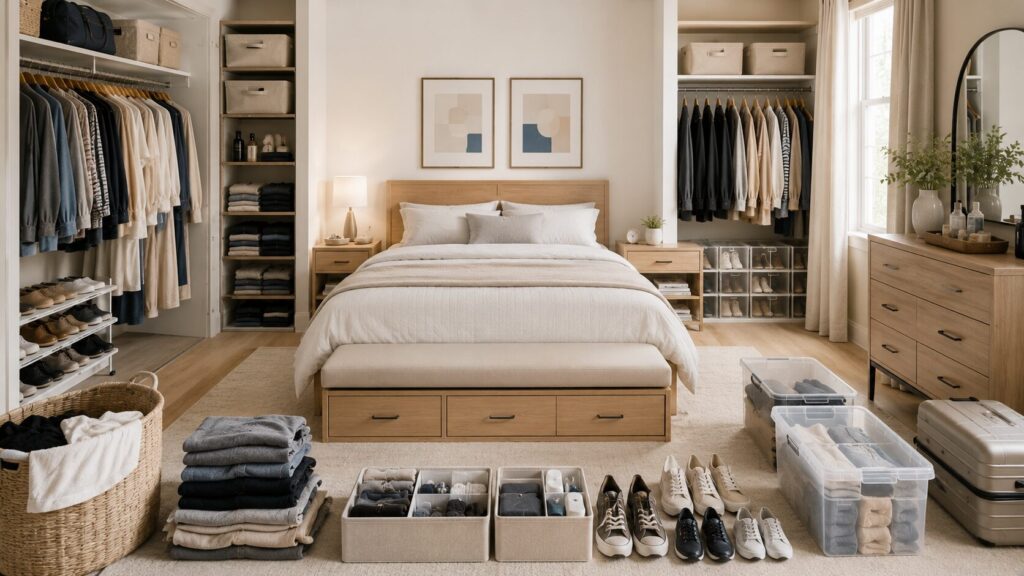
Different schedules mean different routines. One person getting ready at 6 AM while the other sleeps requires storage systems where things are easy to find in low light without disturbing anyone. Digging through a shared pile is both inefficient and a potential source of daily friction.
Different stuff that needs different storage. Men’s and women’s wardrobes often have different compositions — more hanging versus more folded, more accessories versus more shoes, different quantities of each. A storage system that works for one person’s wardrobe won’t necessarily work for the other’s.
Shared surfaces become contested territory. Two people’s nighttime routines — phones, books, glasses, skincare, chargers, water glasses — compete for the same two nightstands. Without clear organization, shared surfaces become the source of low-level daily frustration.
The goal of good bedroom storage for couples isn’t just “more storage.” It’s storage that gives each person clear, easy access to their own things without disrupting the other person’s — and without making the room feel like a warehouse.
The Foundation: Edit Both Wardrobes First
Every storage solution works better with less to store. This is doubly true in a shared small bedroom.
Before you buy a single organizer, shelf, or storage bin, both people need to go through their clothes, shoes, and accessories and make honest decisions about what stays.
The practical approach: go category by category together. T-shirts, then pants, then dresses, then shoes. Each person makes their own decisions — this isn’t a negotiation about the other person’s belongings — but doing it at the same time means you both see what the actual inventory is.
What usually comes out of this process:
- Clothes that haven’t been worn in over a year (not seasonal items — genuinely forgotten items)
- Duplicates that accumulated without notice (how many black T-shirts does one person need?)
- Things kept out of obligation rather than use
- Seasonal items that could be stored elsewhere and rotated in
After a real edit, most couples find they’ve freed up 20–30% of their storage capacity without buying anything. The solutions that follow then work much harder because they’re not trying to contain twice as much as they should.
Small Bedroom Storage Ideas for Couples: Under the Bed
The space under the bed is the single most underused storage area in most bedrooms. In a shared small bedroom, it’s essential.
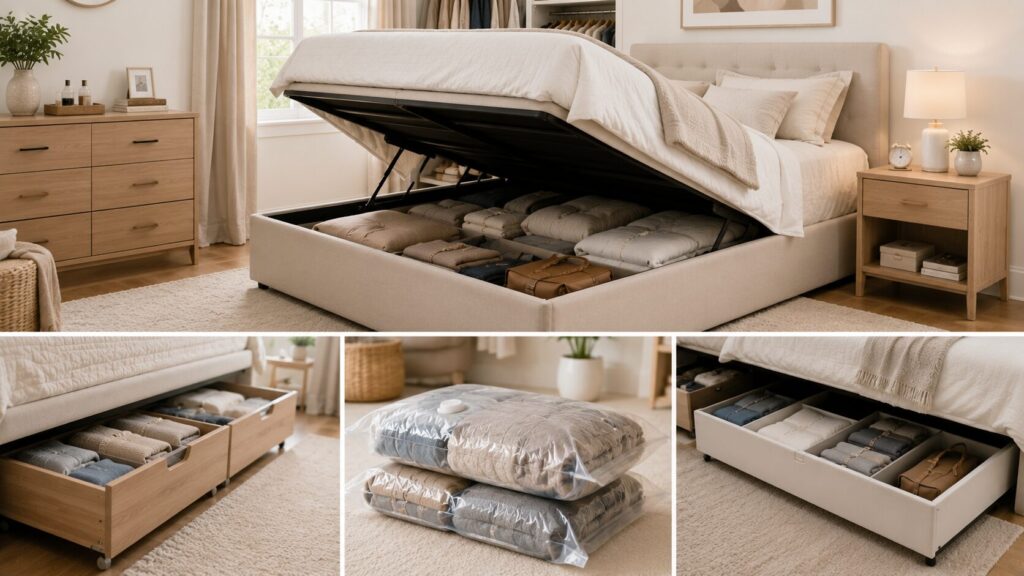
Storage Beds Are Worth the Upgrade
A storage bed — sometimes called an ottoman bed or hydraulic bed — has a lift-up base that reveals a large compartment beneath the mattress. This compartment is typically large enough for:
- All out-of-season clothing from both people
- Extra bedding (duvet sets, spare pillows)
- Bulky items like gym bags or travel gear
- Anything that doesn’t need frequent daily access
For a couple in a small bedroom, a storage bed can replace the need for separate under-bed containers, a linen closet, and sometimes even a portion of what goes in the wardrobe. It’s a single investment that solves multiple problems.
One important note on quality: cheaper storage beds sometimes have weak lift mechanisms that don’t hold the weight of a mattress plus two people’s belongings reliably over time. Spending slightly more on a frame with a strong hydraulic mechanism is worth it.
Low-Profile Under-Bed Rolling Drawers
For beds without built-in storage, rolling under-bed drawers — shallow drawers on wheels that slide out from beneath the bed — make the floor-level space practical for daily use.
Yecaye Under Bed Storage with Wheels
Pack of 2 Under Bed Storage organizers for shoes, clothes, blankets etc.
They work best when:
- The bed frame is high enough off the floor (typically 7+ inches of clearance)
- The drawers are assigned by person rather than shared (one side for each person)
- Contents are labeled or visible without fully removing the drawer
Vacuum storage bags paired with under-bed containers take this a step further for bulky seasonal items — a queen-size comforter compressed into a vacuum bag takes up a fraction of the space it would otherwise.
Closet Storage Ideas for Two: Getting the Division Right
The closet is where most couples’ storage frustration originates. One person has more hanging clothes; the other has more folded items. One person takes up three times the rod space without realizing it. Nobody’s quite sure who owns what side.
Clear division fixes most of this.
Split the Closet Deliberately
Before anything else, agree on how to divide the available closet space. The most practical approach: assign space based on what each person actually needs rather than splitting it exactly 50/50.
If one person has significantly more hanging clothes, they get more rod space. If the other has more folded items, they get more shelf space. The goal is that both people’s things fit their designated space comfortably — not that the split feels mathematically equal.
Use a physical marker — a different hanger color, a shelf divider, even just a gap between sections — to maintain the division over time. Without a marker, closet space tends to expand toward whoever is less careful about staying in their section.
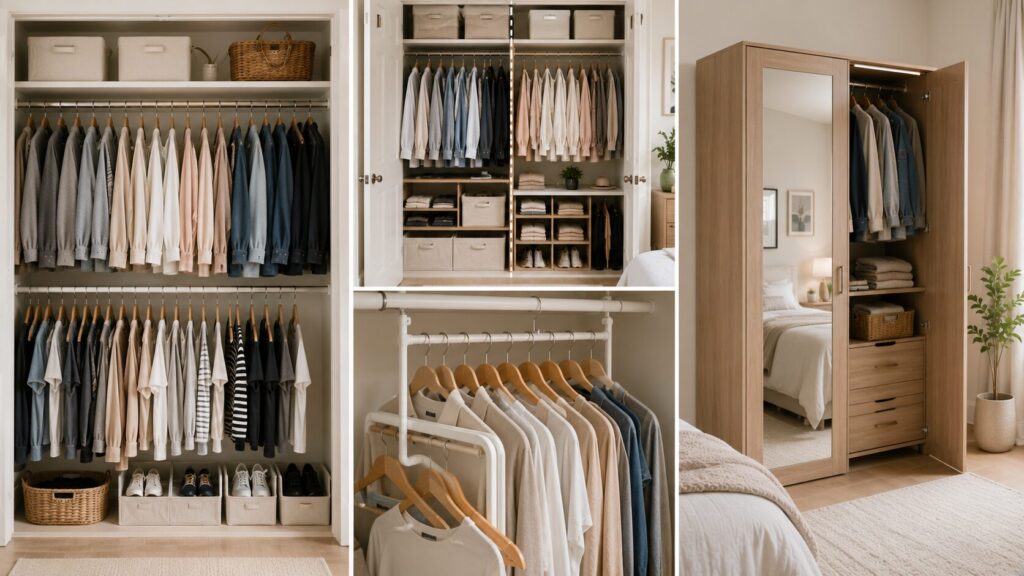
Double the Hanging Space With a Second Rod
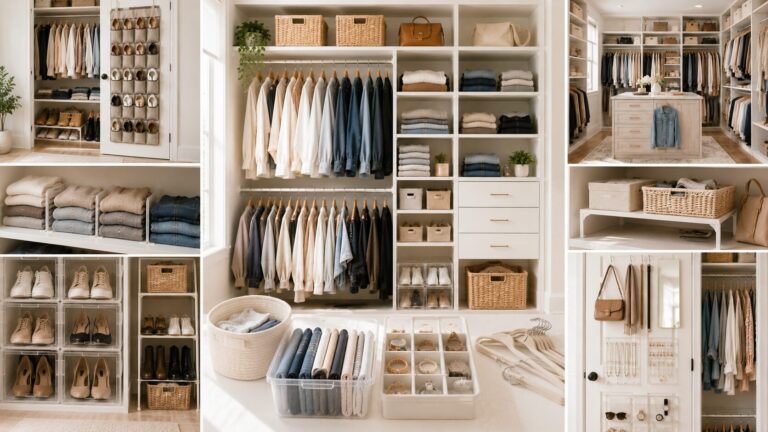
Most reach-in closets come with a single hanging rod. Adding a second rod beneath the first — either a hanging extender that clips onto the existing rod or a freestanding second rod — nearly doubles the available hanging capacity in the lower half of the closet.
This lower rod is ideal for shirts, jackets, and shorter items from both people. The original rod above handles longer pieces: dresses, coats, full-length pants.
A hanging rod extender typically costs $10–$25 and installs in under five minutes. Few storage upgrades in a shared bedroom deliver more value for less effort.
Add a Wardrobe for the Person Who Needs More Space
When the single closet simply doesn’t have enough capacity for two people’s wardrobes — which is common in older apartments with smaller closets — a freestanding wardrobe for one person is often the most practical solution.
Rather than crowding both wardrobes into the closet and creating daily friction over access, give one person the closet and the other a dedicated wardrobe. Many modern wardrobes are designed with internal organization already built in — hanging space, shelves, and sometimes drawers — making them a complete storage solution rather than just overflow space.
Slim-profile wardrobes (18–20 inches deep) work in tighter bedrooms without dominating the room. Designs with mirrored doors add a practical function and help the room feel larger.
Bedside Storage for Two People’s Nightly Routines
Two people’s bedtime routines require more surface area than most standard nightstands provide — especially when you factor in two phones, two sets of chargers, two glasses of water, two books, and whatever skincare or personal items each person uses before sleep.
Choose Nightstands With Built-In Storage
A nightstand with at least one drawer — ideally two — keeps each person’s nightly items off the surface and out of sight during the day. This alone makes the room feel significantly calmer.
Look for:
- At least one drawer for personal items, medication, or items used every night
- A lower shelf or cabinet for books, journals, or a small speaker
- A surface large enough for a lamp plus a few items without feeling crowded
In tight spaces, wall-mounted floating nightstands with a drawer or shelf eliminate the floor footprint entirely and can be positioned at exactly the right height for each person — useful when two people of different heights are sharing the bed.
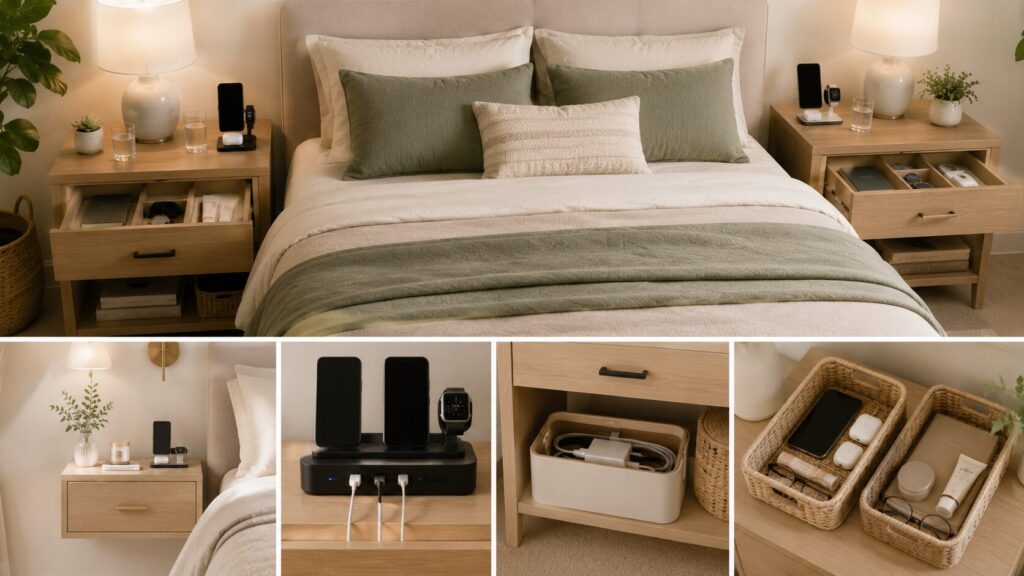
Bedside Charging Stations
Two phones, two pairs of wireless earbuds, a smartwatch — the charging needs of a modern couple are real and messy when managed with loose cables on a nightstand.
A dual charging station (a compact unit with two wireless pads or multiple USB ports) consolidates both people’s charging into one organized spot on a shared nightstand or on a small shelf between the two nightstands. Cord management clips or a cable box underneath the nightstand eliminates the cable mess that otherwise accumulates.
Personal Bins or Trays Keep Surfaces Tidy
If nightstand surfaces tend to become dumping grounds, give each person a designated tray or small bin on their side. Items that belong on the nightstand go in or on the tray — phone, book, lip balm, glasses. The tray creates a visual boundary and, more practically, when you clean the nightstand you just wipe around the tray rather than relocating a dozen loose items.
Vertical Storage: The Shared Bedroom’s Best Asset
When floor space is limited and the closet is at capacity, the walls above furniture height become the most valuable untapped storage in the room.
Floating Shelves Above Each Person’s Nightstand
A shelf mounted 12–18 inches above each nightstand — on their respective side of the bed — doubles the functional bedside storage without adding any furniture footprint.
The nightstand surface handles active daily items. The shelf above holds books, a small plant, a candle, a backup phone charger, or anything else that would otherwise crowd the surface below.
Keeping each person’s shelf distinctly theirs (don’t share a single centered shelf above the headboard for this purpose) maintains the clear division of space that helps a shared bedroom function without daily negotiation.
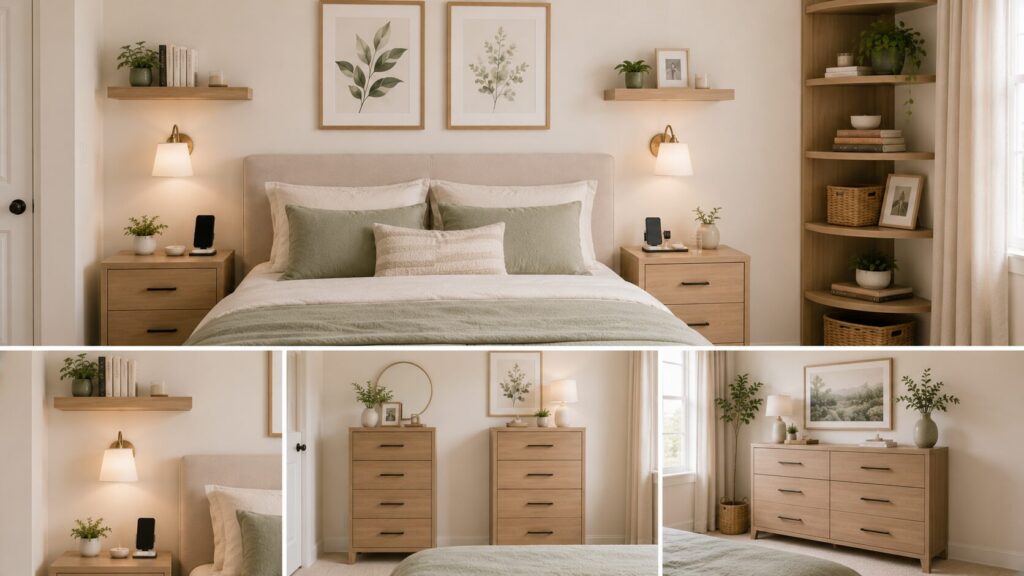
A Shared Dresser vs. Two Smaller Ones
The shared dresser question is one of the most common in small bedrooms for couples. Is one large dresser better than two smaller ones?
The answer depends on the room layout and the two wardrobes involved.
One large dresser works when there’s a clear wall for it, the dresser has enough drawers for both people (at minimum three drawers per person), and both people agree clearly on which drawers belong to whom. A 6-drawer dresser divided down the middle (top three for one person, bottom three for the other, or three on each side of a 3-column dresser) can work efficiently.
Two smaller chests of drawers works better when the wardrobes are very different in composition (one person needs mostly hanging, the other mostly folded), when one person’s dresser can go in a different part of the room from the other’s, or when a single large dresser would dominate the available wall space.
In most small bedrooms, two narrow chests (24 inches wide, 18 inches deep) take up the same wall space as one wide dresser while giving each person complete ownership of their storage.
Floor-to-Ceiling Shelving in One Corner
A corner shelf unit that goes from floor to ceiling uses the dead corner space that’s otherwise wasted and creates a significant amount of vertical storage without claiming a full wall.
In a shared bedroom, a corner shelf unit works well for shared items — extra bedding, books, small electronics, decor — that don’t clearly belong to either person. Keeping shared items in one designated location rather than scattered across both people’s spaces reduces the “where did you put the—” conversations considerably.
Dual-Function Furniture That Earns Its Place Twice
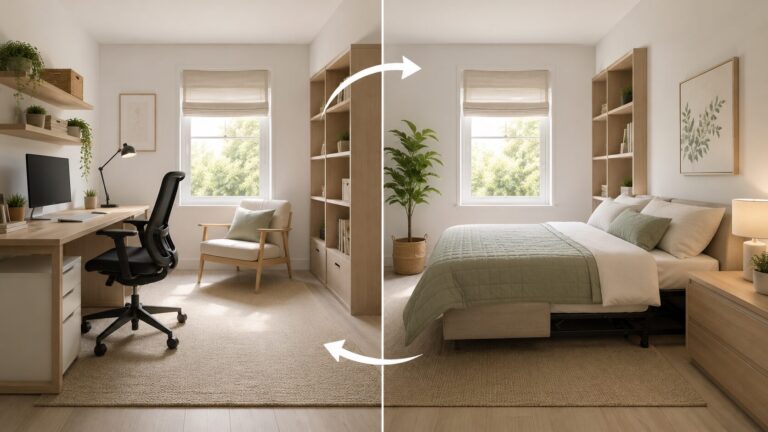
In a small bedroom for two people, every large furniture piece needs to justify its floor footprint. Multi-functional furniture — pieces that serve two purposes instead of one — is how shared small bedrooms stay functional without feeling overrun.
The Bench at the Foot of the Bed
A storage bench at the foot of the bed is one of the most practical furniture additions for a shared bedroom. It provides:
- A surface for laying out tomorrow’s outfit (reducing morning closet access during the other person’s sleep hours)
- Extra seating when one person is getting ready
- Internal storage (in bench designs with a hinged lid) for blankets, off-season accessories, or gym gear
A bench also adds a finishing layer to the room aesthetically — it makes the bed arrangement look more complete and designed rather than just a mattress on a frame.
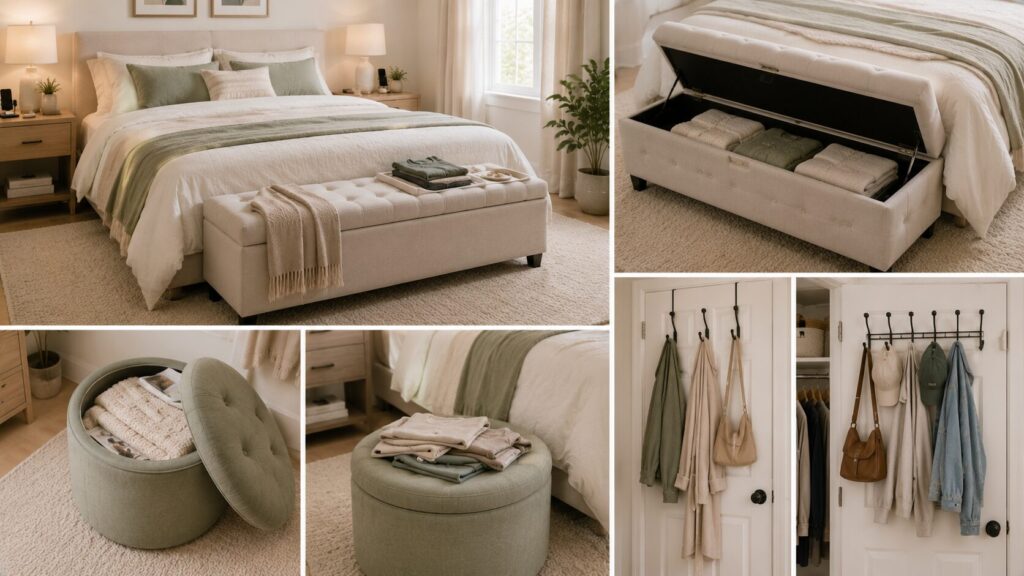
Ottoman With Storage Instead of a Dedicated Accent Chair
If the bedroom has room for one additional seating piece beyond the bed, an upholstered ottoman with internal storage is a more practical choice than a standard accent chair for a shared small bedroom.
It serves as a seat, a surface for laying out clothes, and hidden storage — three functions from one piece with a relatively compact footprint. An accent chair, by contrast, provides only seating.
Hooks on the Back of the Door and Inside the Closet
The back of the bedroom door and the inside of the closet door are two of the most consistently underused storage surfaces in small bedrooms.
A set of hooks on the back of the bedroom door holds tomorrow’s outfits, robes, bags, and gym gear without using any floor or shelf space. In a shared bedroom, assign the upper hooks to one person and the lower hooks to the other — a simple division that eliminates any confusion about what belongs to whom.
Bedroom Storage Ideas for Small Bedrooms: Keeping It Maintained
The best storage system in the world doesn’t help if it deteriorates over two weeks. Shared small bedrooms need simple maintenance habits more than individual ones do — because disorganization from one person affects both people’s experience of the room.
The Sunday Reset
A five-minute shared reset at the end of the week — both people putting their things back in their designated spots, clearing any items that drifted out of their zones, removing anything that doesn’t belong in the bedroom — keeps the room from accumulating the low-grade clutter that builds up across seven days.
Five minutes of shared maintenance weekly beats an hour of frustrated re-organizing every month.
The One-In, One-Out Rule for Two
The one-in, one-out rule (for every new item that enters, one item leaves) is useful for individuals and essential for couples sharing a small space. New shoes for one person means one pair donates or goes into seasonal storage. A new sweater means an old one moves on.
The discipline required is actually less than it sounds — it’s mainly a habit of awareness that prevents the slow accumulation that leads back to the original problem.
Quick Reference: Best Bedroom Storage Ideas for Couples
Under the bed:
- Storage/ottoman bed with hydraulic lift mechanism
- Rolling under-bed drawers assigned by person
- Vacuum bags for seasonal and bulky items
Closet:
- Deliberate 50/50 (or need-based) division with physical markers
- Hanging rod extender for doubled capacity
- Separate wardrobe if closet doesn’t fit two wardrobes
Bedside:
- Nightstand with at least one drawer per person
- Floating wall-mounted nightstands in very tight spaces
- Dual charging station for two people’s devices
- Personal tray or bin to define each person’s surface area
Vertical and wall storage:
- Floating shelf above each person’s nightstand
- Two narrow chests vs. one shared dresser (based on wardrobe type)
- Floor-to-ceiling corner shelving for shared items
- Hooks on back of bedroom door divided by person
Multi-function pieces:
- Storage bench at foot of bed
- Storage ottoman instead of accent chair
- Inside-closet-door organizers for accessories
Conclusion
Sharing a small bedroom as a couple is fundamentally a storage design problem — and like all design problems, it responds well to intentional, practical solutions.
The strategies that make the biggest difference aren’t dramatic renovations or expensive built-ins. They’re the basics done well: clear division of who gets what space, under-bed storage that handles the overflow, vertical shelving that replaces floor furniture, and multi-functional pieces that do more than one job.
What makes these ideas work specifically for couples rather than just for individuals is the division principle. Clear, agreed-upon boundaries for each person’s storage — their side of the closet, their nightstand, their drawers — remove the daily low-level negotiation that makes a shared small bedroom feel chaotic. When both people’s things have an obvious home, the room stays organized with far less effort.
Start with the edit. Then tackle under-bed storage, since it’s the highest-impact change most shared bedrooms can make without moving furniture. Work out from there into the closet and vertical space.
A small bedroom for two people, organized thoughtfully, doesn’t feel like a compromise. It feels like a room that works — for both of you.
FAQs. (Frequently Asked Questions):
How do two people share a small bedroom closet?
Divide the closet deliberately based on what each person actually needs rather than splitting it 50/50. If one person has mostly hanging clothes, they get more rod space. If the other has more folded items, they get more shelf space. Mark the division with a physical boundary — different colored hangers, a shelf divider, or even just a clear gap between sections. Add a second hanging rod (a $10–$25 extender) below the existing one to nearly double the rod capacity, then assign each level to a specific category rather than leaving it first-come, first-served.
What’s the best bed for a couple in a small bedroom?
A storage bed (hydraulic/ottoman lift base) is the single most impactful furniture upgrade for a couple in a small bedroom. The storage space beneath the mattress handles seasonal clothing, extra bedding, and bulky items from both people — eliminating or reducing the need for separate storage furniture. For the size: a queen (60″×80″) is the standard for couples and fits in most small bedrooms with adequate clearance. A full (54″×75″) works if clearance is very tight. A king (76″×80″) usually isn’t practical in bedrooms under 12 feet wide.
Should couples have separate dressers or share one?
Two narrow chests of drawers (24 inches wide, 18 inches deep each) is usually better than one large shared dresser for couples in a small bedroom. Each person gets complete ownership of their storage with no division ambiguity, and two narrow chests typically take up the same total wall width as one large dresser while being easier to position in smaller rooms. A single shared dresser works if it has at least six drawers (three clearly assigned to each person) and both people are consistent about staying in their designated drawers.
How do you organize a small bedroom when one person is messier than the other?
The most effective approach is designing a system where putting things away is easier than leaving them out — for both people, regardless of natural tidiness levels. Every item needs a designated place that’s genuinely accessible: hooks for bags and tomorrow’s clothes rather than a chair, a personal tray on the nightstand rather than a loose pile, a laundry hamper in the room rather than on the closet floor. The messier person isn’t usually messy by preference — they’re often messier because putting things away is harder than it should be. Friction-free storage design helps both partners.
How do we store shoes in a small shared bedroom?
Allocate shoe storage by person and by access frequency. Daily-wear shoes for both people go near the door or in the most accessible closet floor space — a low shoe rack with each person’s side marked. Less-worn shoes go in clear shoe boxes (stackable, labeled) on closet shelves. Out-of-season or rarely worn shoes go in under-bed storage. If closet floor space is very limited, an over-the-door shoe organizer on the inside of the closet door holds 18–24 pairs without using any floor or shelf space — assign half to each person. Keeping shoe inventories edited (one in, one out per person) is the other half of making this work long-term.