Closet Organization Ideas That Actually Stick (No Custom Build Required)
Here’s the honest truth about messy closets: the problem is almost never a lack of space. It’s a lack of system.
Most closets fail because things get shoved in without a clear home. The floor becomes a pile. The single hanging rod holds twice what it should. The shelf on top collects things you’ve forgotten exist. Over time, the closet becomes something you open with one hand, grab quickly, and close before anything falls out.
The good news? You don’t need a closet renovation or a custom built-in system to fix this. The best closet organization ideas work with what you have — your existing layout, your actual wardrobe, and a realistic budget.
This guide covers everything: how to start, what storage products genuinely help, how to organize specific closet types, and the closet organization tips that keep things tidy after the initial effort. Whether you’re dealing with a small reach-in closet, a shallow hallway nook, or a walk-in that’s lost control, there’s a workable system here for you.
Let’s start at the beginning — because skipping this step is why most closet organizing attempts don’t last.
Before You Buy Anything: The Edit First
Every professional organizer says the same thing, and it’s true: buying storage products before you know what you’re storing is a waste of money.
Before you order a single bin, hanger, or shelf divider, you need to empty the closet and make decisions.
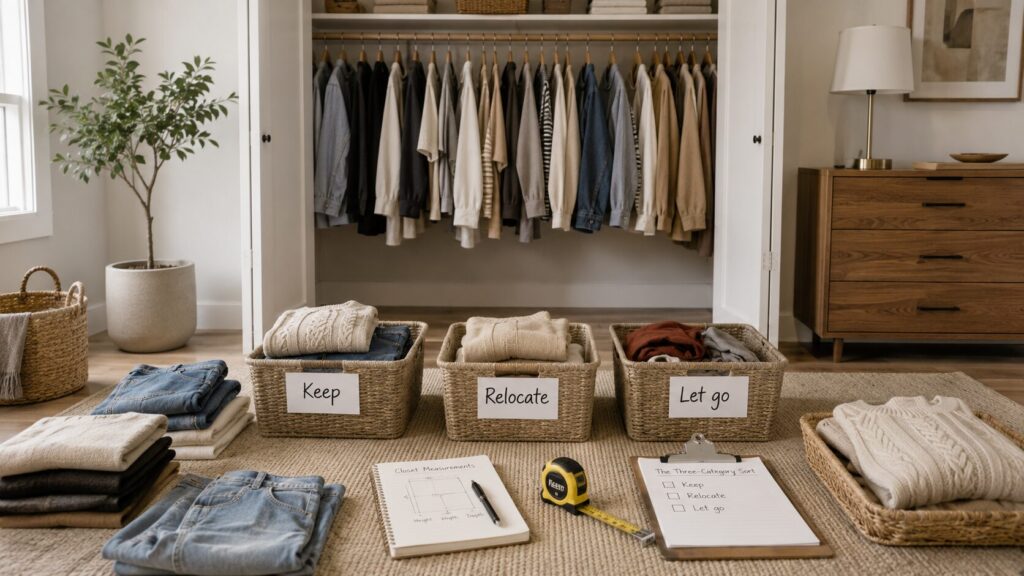
The Three-Category Sort
Pull everything out and sort into three honest categories:
- Keep — things you actually use and want to keep in this closet
- Relocate — things that belong somewhere else in your home
- Let go — items to donate, sell, or discard
The “relocate” pile is often larger than people expect. Closets become dumping grounds for things that don’t have a proper home elsewhere. Fixing that is part of the organizing process — not a distraction from it.
The 12-Month Rule (With Caveats)
The standard advice is: if you haven’t used it in a year, let it go. That’s a reasonable starting point, but apply some judgment. A winter coat you didn’t need last year because of weather is different from a blazer you’ve been avoiding because it never quite fits right.
What you’re really asking is: does this item earn its space? If the answer is uncertain, that’s usually a no.
Measure Before You Shop
Once you know what you’re keeping, measure the closet. Width, depth, and height — including the height from floor to the existing rod, rod to shelf, and shelf to ceiling. These measurements determine exactly what products will work and what won’t. Buying storage solutions without measurements is how you end up with bins that don’t fit and shelves with wasted space above them.
Closet Organization Ideas for Hanging Clothes
Most reach-in closets have one hanging rod. That single rod is the source of the majority of closet chaos, and it’s also the easiest thing to improve.
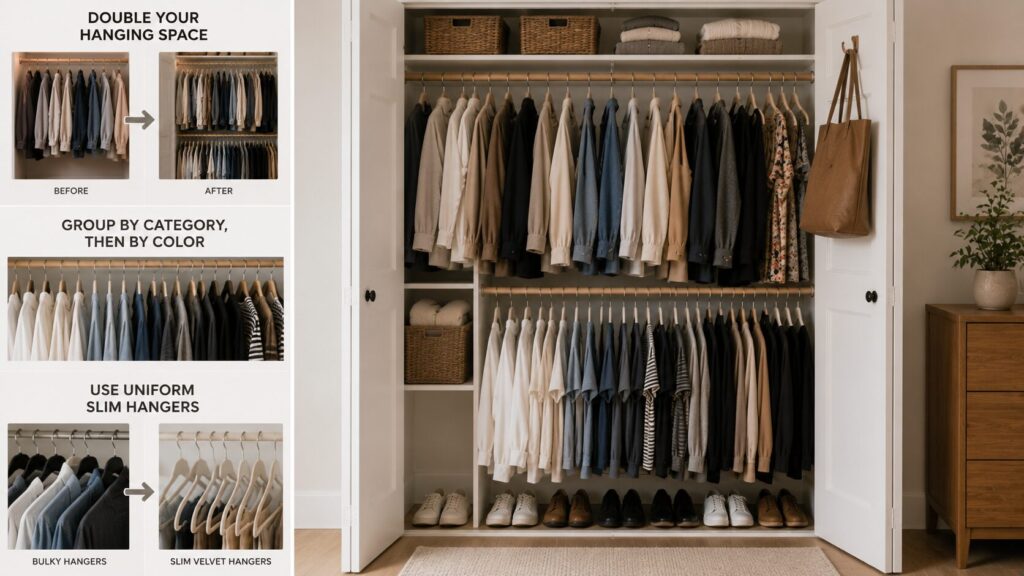
Double Your Hanging Space With a Second Rod
A simple hanging rod extender — a short rod that drops down from the existing one — instantly doubles your hanging capacity in the lower half of the closet. This works beautifully for shirts, jackets, folded pants, and shorter items.
The upper portion of the original rod can then hold longer items: dresses, full-length pants, coats.
This costs between $10 and $30 and requires zero installation. It’s one of the highest-impact closet storage ideas available for the price.
Group by Category, Then by Color
Once you have your hanging space sorted, organize clothes by category first (all shirts together, all pants together, all jackets together) and then by color within each category. This sounds unnecessarily precise, but it serves a real function: you can find things quickly, and you can see at a glance when a section is getting overcrowded.
Color organization also surfaces duplicates. If you’re looking at seven navy blue tops all in a row, you’ll think twice before buying another one.
Use Uniform Slim Hangers
Bulky plastic hangers take up significant space on a rod — sometimes 30–40% more space than necessary. Switching to slim velvet hangers (the non-slip kind) allows you to fit considerably more on the same rod length and keeps everything at a consistent height.
The velvet surface also keeps items from slipping off, which reduces the pile on the closet floor that happens when clothes slide off smooth plastic hangers.
It’s a small change with a surprisingly visible impact on how organized the closet looks and functions.
Closet Storage Ideas for Folded Items and Shelves
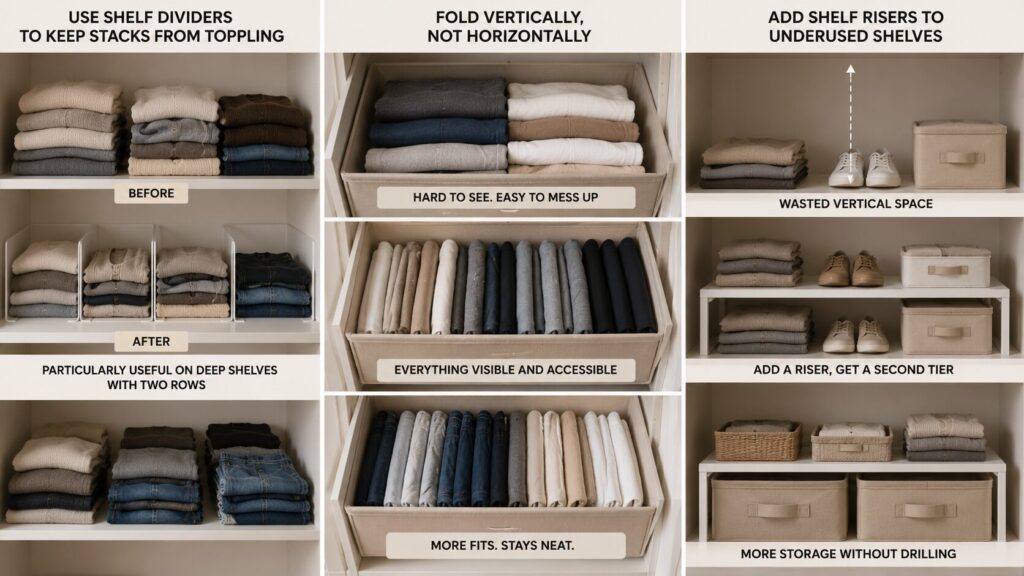
Use Shelf Dividers to Keep Stacks From Toppling
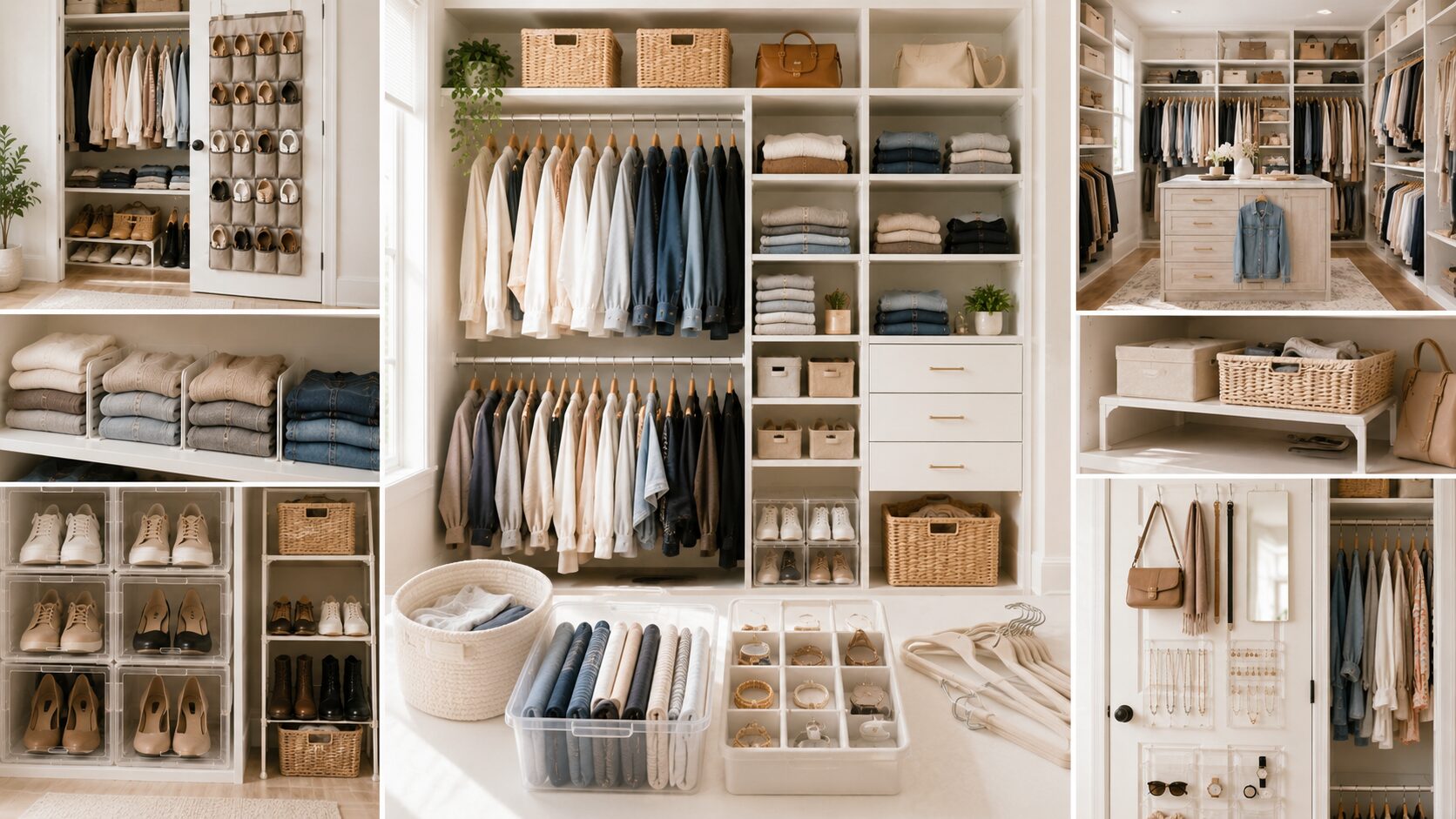
Folded sweaters and jeans look neat for exactly one retrieval and then collapse into a leaning tower. Shelf dividers — simple L-shaped brackets that clip onto the shelf — create individual sections that keep stacks upright and separated.
This is particularly useful on deep shelves where you might have two rows of stacks: one near the front, one near the back.
Fold Vertically, Not Horizontally
The file-fold method (also called the KonMari fold) stores items vertically in a drawer or bin rather than stacking them flat. Instead of lifting off the top item to get to the one underneath, every item is visible and accessible at once.
This method is genuinely transformative for drawers and bins on shelves. It takes a few extra seconds per item when putting laundry away, but it means you never have to dig through a pile again.
Try it with T-shirts first. Once you see how many more fit — and stay visible — you’ll fold everything this way.
Add Shelf Risers to Underused Shelves
If you have a shelf with 18 or more inches of vertical clearance above it, you’re wasting storage space. A simple shelf riser (a small elevated shelf that sits on top of the existing one) creates a second tier within that clearance for smaller items — folded clothes, shoe boxes, bins.
This is a zero-tools closet organization hack that effectively adds a shelf without drilling anything.
Shoe Storage: The Part Most People Get Wrong
Shoes are one of the hardest categories to organize because they come in irregular shapes, they take up floor space, and there are usually a lot of them.
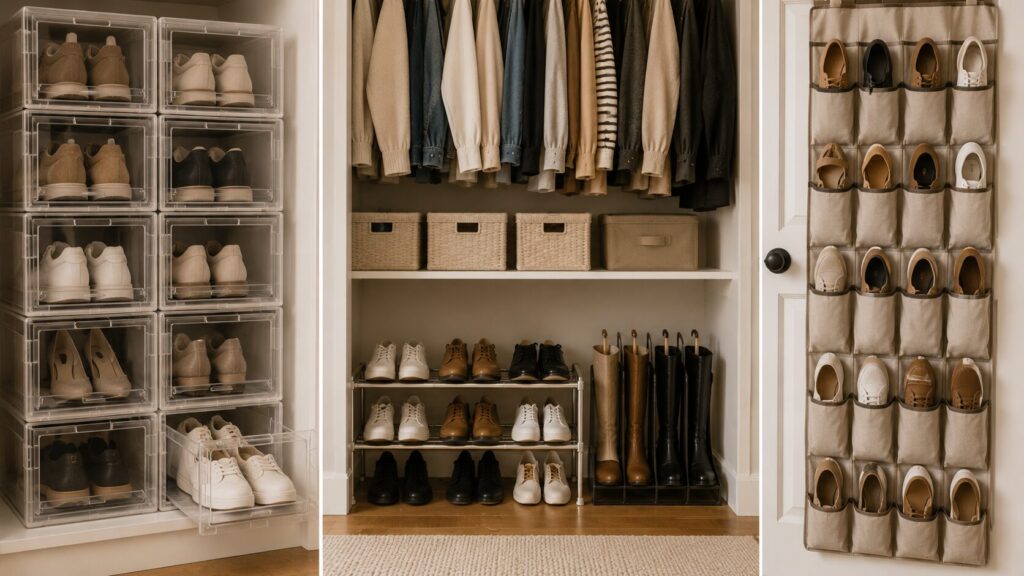
Clear Shoe Boxes for Easy Identification
Stacking opaque shoe boxes looks tidy from a distance but creates a new problem: you can’t see what’s inside without unstacking everything. Clear shoe boxes (or boxes with a photo label on the front) solve this immediately.
The drop-front clear shoe box design is particularly practical — you can open the box from the front without removing it from the stack, which is much more realistic for daily use than lifting a heavy stack to get to the bottom pair.
Over-the-Door Shoe Organizers for Small Closets
An over-the-door shoe organizer makes use of the back of the closet door — space that’s almost always wasted. Standard designs hold 18–24 pairs in a pocket configuration and require no hardware beyond the door hooks.
One important note: these work best for flat shoes, sneakers, and sandals. Heels and boots need a different solution (see below).
Use the Floor Space Strategically
The closet floor is prime real estate that often gets buried under a pile of things. Once it’s clear, use it intentionally: a low shoe rack near the front for daily-wear shoes, and boot storage (a boot shaper or angled boot rack) against the back wall.
Storing only your current-season shoes in the closet and boxing up out-of-season pairs frees up enormous floor and shelf space.
Walk-In Closet Organization Ideas
Walk-in closets have more space to work with, but they also tend to accumulate more and get disorganized in different ways. The key is zoning.
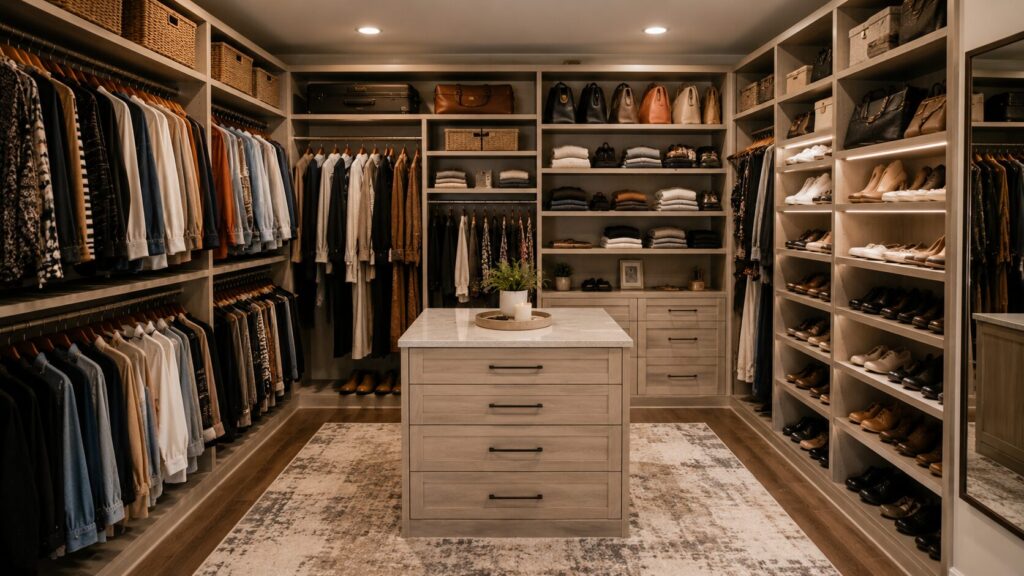
Divide the Space Into Zones
Treat a walk-in closet like a mini room — because it is one. Designate specific zones for specific categories:
- Daily-use zone — closest to the door, for things you reach for most often
- Hanging zone — long items on one side, doubled-up shorter items on the other
- Shelf zone — folded items, bins, bags, and accessories
- Shoe zone — typically along one wall or across the back
- Seasonal/archive zone — highest shelves and back corners for less-accessed items
Clear zones mean everything has a place. When something doesn’t have a place, it ends up on the floor — that’s the real reason walk-ins get messy.
Add a Small Dresser or Island
If your walk-in is large enough (typically 8 feet wide or more), a small dresser or low island in the center adds drawer storage for items that don’t hang well — underwear, socks, gym clothes, accessories — and creates a surface for laying out outfits.
A free-standing dresser that fits the space is far less expensive than a custom-built island and does the same functional job.
Use the Ceiling Height
In most walk-in closets, there’s usable space above the standard shelf-and-rod height that goes completely unused. Installing a second shelf above the main one — even just 12 inches deep — creates storage for seasonal items, luggage, or clearly labeled bins.
If the ceiling is too high to reach conveniently, a small step stool stored in the closet makes upper shelves practical rather than theoretical.
Small and Reach-In Closet Organization Hacks
Not everyone has the luxury of a walk-in. Small reach-in closets present different challenges — mainly, that depth and width are limited, so every inch counts.
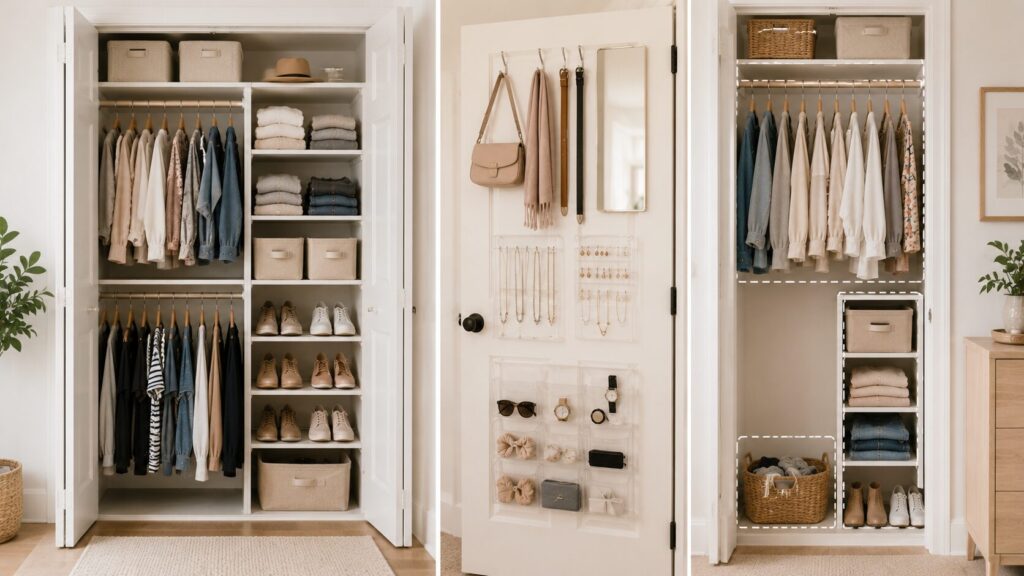
Install a Full-Height Shelving System
Standard reach-in closets typically have one rod and one shelf. Replacing this with a full-height shelving system — either a purchased modular kit or custom-cut shelves — gives you complete control over the configuration. You can add more hanging areas, create dedicated cubby spaces for folded items, or include a section with multiple shelves for shoes and bins.
Modular closet systems from home improvement stores (adjustable wire or laminate systems) are designed for DIY installation and can transform a basic reach-in for a few hundred dollars, no carpenter needed.
Use Every Inch of Door Space
Beyond the shoe organizer mentioned earlier, closet doors can hold:
- Hooks on the back panel for bags, belts, scarves, or tomorrow’s outfit
- A small mirror (saves bathroom counter time)
- A mounted jewelry organizer for necklaces and earrings
- A pocket organizer for small accessories — sunglasses, watches, phone chargers
The back of the door is one of the most underused storage surfaces in most homes.
Think in Zones Even in Small Spaces
Even a 3-foot-wide closet benefits from zoning. Left side for hanging, right side for shelves. Top shelf for items you access less than once a week. Floor for shoes and a small basket for things you’re currently deciding on (a “maybe” bin with a size limit — when it fills up, you have to make decisions).
Small space zoning keeps the closet from reverting to chaos after a week.
The Maintenance System: How to Keep It Organized
This is the part most closet organization guides skip. Getting organized is satisfying. Staying organized is a habit.
The One-In, One-Out Rule
For every new item that enters the closet, one item leaves. This applies to clothes, shoes, bags — everything. It prevents the slow accumulation that leads back to the original problem.
It sounds strict, but in practice it’s a natural check: before buying something new, you’re prompted to think about what it’s replacing. That pause alone cuts impulse purchases and keeps the closet in balance.
Sunday Resets Take Five Minutes
A five-minute reset at the end of the week — hanging up anything that’s been draped over chairs, returning items to their zones, clearing any pile that’s started on the floor — keeps the closet from deteriorating between deeper seasonal tidies.
Five minutes of maintenance every week beats two hours of full reorganization every few months.
Seasonal Rotation Keeps Things Manageable
Store out-of-season clothing (winter coats and sweaters in summer, swimwear and linens in winter) in bins on upper shelves or under the bed. This alone can cut the active closet’s contents by 30–40%, making everything in it easier to access and easier to maintain.
Use vacuum storage bags for bulky items like comforters and heavy sweaters — they compress significantly and allow much more to fit in the same shelf space.
Quick Reference: Best Closet Organization Products by Category
For hanging clothes:
- Slim velvet hangers (replace bulky plastic)
- Hanging rod extender (doubles hanging space)
- Specialty hangers for pants, scarves, and bags
For folded items and shelves:
- Shelf dividers (keep stacks upright)
- Clear stackable bins with lids
- Shelf risers (add a second tier on existing shelves)
For shoes:
- Clear drop-front shoe boxes
- Over-the-door shoe pocket organizer
- Low shoe rack for daily-wear pairs
- Boot shapers and angled boot racks
For small items and accessories:
- Over-door pocket organizer
- Drawer dividers for jewelry and accessories
- Small hooks for bags and belts
For seasonal storage:
- Vacuum compression bags for bulky items
- Clearly labeled bins for top shelves
- Under-bed flat storage containers
Conclusion
The best closet organization ideas aren’t about aesthetics — though a well-organized closet does look great. They’re about building a system where every item has a place, everything is accessible, and the space maintains itself with minimal effort.
The starting point is always the edit. Before you add a single storage product, reduce what you’re storing. The less you keep, the less you have to organize, and the longer any system lasts.
From there, it’s about maximizing your vertical space, using the right products for the right categories, and building a small maintenance habit into your weekly routine. None of this is complicated. The tools are affordable, the strategies are straightforward, and the results are immediate.
Start with one closet — whichever one bothers you the most — and apply these ideas one section at a time. Empty it, sort it, measure it, then put it back together with intention.
That single closet becoming calm and functional tends to create momentum. Most people find they want to apply the same system to every storage space in the house after that. And that’s a very good problem to have.
What is the best way to start organizing a closet?
Start by emptying it completely. Pull everything out and sort into three groups: keep, relocate (things that belong somewhere else), and let go (donate, sell, or discard). Don’t buy any storage products until after this step — you need to know exactly what you’re keeping and how much of it there is before you can shop for solutions that actually fit. Measure your closet dimensions once it’s empty so you know what products will work.
How do I organize a small closet with limited space?
Focus on maximizing vertical space first. Add a second hanging rod beneath the existing one for shorter items. Use shelf risers to create a second tier on existing shelves. Mount hooks or a pocket organizer on the back of the door. Switch to slim velvet hangers to fit more on the rod. Store out-of-season items elsewhere — upper shelves or under the bed — so only active-season items occupy the main space. These changes alone can dramatically improve a small closet without any renovation.
What’s the best way to store shoes in a closet?
Clear drop-front shoe boxes are ideal for shoes you wear less frequently — they stack, protect the shoes, and let you see what’s inside without unstacking everything. For daily-wear shoes, a low shoe rack near the closet entrance is the most practical. If floor space is tight, an over-the-door pocket organizer holds 18–24 pairs of flat shoes without using any floor or shelf space. Boots need different treatment — boot shapers keep them upright and prevent creasing.
How do I keep my closet organized long-term?
Two habits make the biggest difference: the one-in, one-out rule (every new item that enters means one item leaves) and a weekly five-minute reset. The one-in, one-out rule prevents gradual accumulation. The weekly reset — just putting misplaced items back in their correct spots and clearing any floor piles — keeps the system from deteriorating between seasonal tidies. Neither habit requires much effort, but together they make a big difference.
Are closet organization systems worth the money?
Modular closet systems (adjustable laminate or wire systems from home improvement stores) are genuinely worth it for most reach-in closets. They let you configure the space around your actual wardrobe rather than the default one-rod, one-shelf setup that almost no wardrobe fits well. Costs typically range from $150 to $400 for a standard reach-in, and installation is DIY-friendly. Custom built-ins cost significantly more and make sense for walk-in closets or if you’re staying in a home long-term. For most people, a mid-range modular system hits the sweet spot of cost, flexibility, and impact.