Affordable Small Apartment Living Room Ideas on a Budget – A Smart Shopping Guide
Furnishing a small living room on a budget usually turns into one of two outcomes. Either everything gets bought cheap, and the room looks like it — thin fabric, wobbly frames, a collection of things that don’t quite go together. Or one or two “nice” items get purchased at full price, and the budget runs out before the room is actually finished.
Neither outcome is really about how much money was available. It’s about not having a plan for where that money should go.
The smarter approach — the one actual designers use even on large budgets, not just tight ones — is deciding in advance which categories deserve real investment and which categories perform just as well at the lowest price point available. Some things genuinely are worth spending more on. Others aren’t, and spending more on them doesn’t buy you a better-looking room, just a more expensive one that looks the same.
This guide walks through affordable small apartment living room ideas organized exactly that way: what to splurge on, what to save on, and specifically where to find good quality at low prices for each category. It’s built for real budgets, real small living rooms, and the actual decisions that determine whether an affordable room looks affordable or looks considered.
The Splurge-vs-Save Framework
Before the specific categories, here’s the underlying logic that makes budget furnishing actually work.
Splurge on items that get daily physical contact and are expensive to replace. The sofa, primarily — anything you sit on for hours daily needs to hold up structurally and stay comfortable, and a genuinely cheap sofa frame or cushion fill degrades noticeably within a year or two, at which point you’re buying a second one anyway.
Save on items that are primarily visual and easy to swap. Decorative objects, art, cushion covers, small accent pieces — these can be inexpensive without any real downside, because their job is visual, they don’t bear weight or daily wear, and you can always upgrade them individually later without redoing the whole room.
Save on items where secondhand delivers equal or better quality. Side tables, frames, lamps, mirrors — the secondhand market for these categories is strong, and a well-made vintage or thrifted piece frequently outperforms a new budget equivalent in both looks and durability.
Splurge selectively on one “hero” piece per room. A single higher-quality item — a well-made rug, a genuinely good lamp, one well-constructed chair — gives the room a quality anchor that budget items around it can lean on visually. A room entirely made of the cheapest available version of everything reads as uniformly cheap; a room with one clearly higher-quality piece reads as considered, even if everything else was inexpensive.
Affordable Small Apartment Living Room Ideas: The Sofa
Where to Spend
The sofa is the one category in this guide where spending more, within reason, pays off directly. A frame built from solid wood or engineered hardwood, cushions with a genuine foam or down-blend fill, and a fabric rated for real durability (double rub count above 15,000, if the retailer provides that spec) will noticeably outlast a budget sofa built from particleboard and low-density foam.
This doesn’t mean the most expensive sofa available — it means budgeting more of the total living room spend toward this one piece than toward anything else, because it’s the item that will show wear fastest and cost the most to replace if the initial purchase was poor quality.
Affordable Options That Still Deliver Quality
Facebook Marketplace and local secondhand sources frequently have quality sofas — sometimes barely used, from people relocating or upgrading — at a fraction of retail cost. This is genuinely the highest-value sourcing strategy for a sofa specifically, since a well-made secondhand sofa in good condition often outperforms a new budget sofa at the same price point.
Mid-range retailers with a track record for sofa durability (Article, Burrow, and similar direct-to-consumer brands, along with IKEA’s higher tier sofa lines like the Söderhamn or Landskrona) offer better construction than the very lowest-price sofa options without reaching designer pricing.
Reupholstering a secondhand frame is worth considering if you find a structurally sound sofa with a solid wood frame but dated or worn fabric. Reupholstery costs vary significantly by region and fabric choice, but for a genuinely good frame, it’s often more economical than buying new — and the result is a piece built to last considerably longer than most budget new options.
If the Budget Is Very Tight
A quality futon or sofa bed from a reputable budget retailer, or a well-reviewed loveseat rather than a full three-seat sofa, both reduce cost while still providing genuine seating comfort — better than stretching to a full-size sofa at the very lowest price tier, where quality drops sharply.
The Rug
Where to Save (Mostly)
Rugs are one of the more forgiving categories for budget shopping, because a well-chosen budget rug in the right size does most of the visual work regardless of price point — the sizing matters more than the cost.
IKEA’s flatweave and jute rug lines are consistently well-reviewed for the price and available in sizes large enough to properly anchor a small living room seating area. Rugs USA during sale periods (which happen frequently) offers a wide range of styles at accessible prices. Ruggable, while priced slightly higher than the absolute budget tier, offers a washable design that’s genuinely valuable in a living room that sees regular use and potential spills.
The One Place to Splurge Slightly
If any single upgrade in the rug category is worth the extra cost, it’s size. A too-small rug at any price point undermines the room; a properly sized budget rug completes it. If choosing between a smaller “nicer” rug and a larger basic one within the same budget, the larger basic rug almost always produces a better-looking room.
Lighting
The Highest-Value Category in This Entire Guide
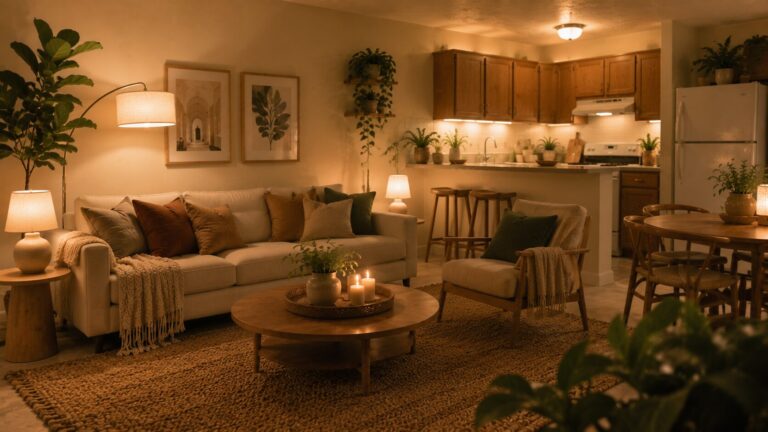
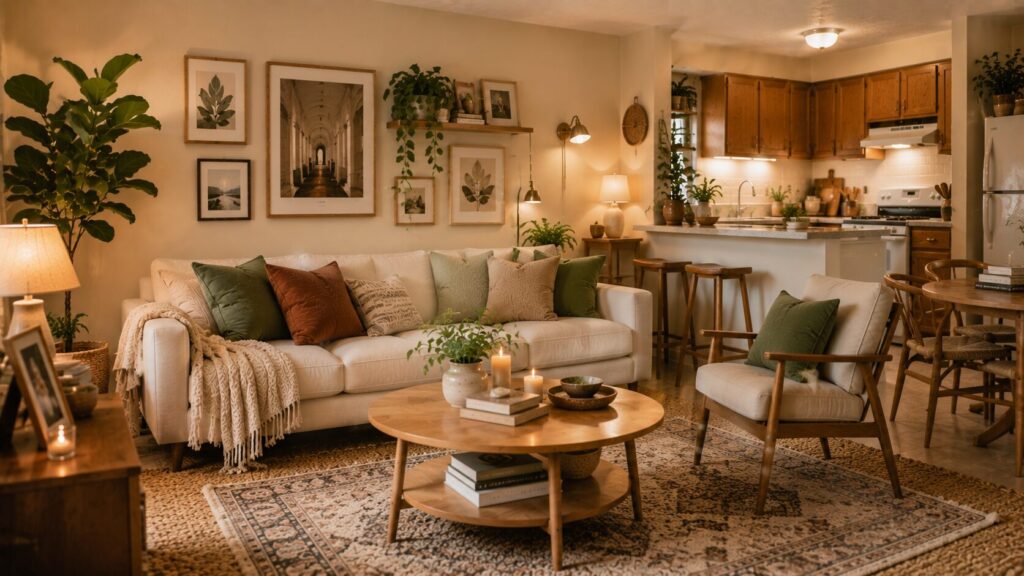
Lighting delivers more visible transformation per dollar spent than any other living room category, and it’s almost entirely a “save” category — there’s very little correlation between light fixture price and actual visual impact, as long as the bulb temperature and fixture placement are right.
Warm white LED bulbs (2700K) across every fixture in the room cost $15–$25 total for a full living room and produce the single biggest atmospheric shift available at this price point.
A budget floor lamp ($25–$50 from IKEA, Target, or Amazon) adds a second light source at floor height, which does more for the room’s evening atmosphere than almost any decorative purchase at a similar price.
A table lamp on a console or side table ($15–$35) completes the layered lighting the room needs — three light sources (overhead, floor, table) at different heights consistently outperform a single ceiling fixture regardless of how much any individual fixture costs.
Coffee Tables and Side Tables
Save Here, With One Caveat
Coffee tables and side tables are primarily surfaces — they don’t need structural durability on the level a sofa does, and budget options in solid wood or metal (rather than laminate over particleboard, which chips and looks worn faster) hold up reasonably well even at low price points.
IKEA’s LACK and LISABO lines, Target’s Threshold and Project 62 collections, and secondhand sources all deliver functional, decent-looking tables well under $100, often well under $50.
The caveat: avoid the absolute lowest tier of laminate tables if the piece will see daily use — a coffee table that gets used as a footrest, a laptop stand, and a place to set drinks needs slightly more durability than the cheapest available option typically provides. One step up from the bottom price tier usually solves this without a significant cost increase.
Nesting Tables as a Budget-Smart Choice
A set of two or three nesting tables often costs less combined than a single larger coffee table of comparable quality, while providing more functional flexibility (separating them for a gathering, nesting them back for daily use). This is a genuinely underused budget strategy — nesting sets are frequently overlooked in favor of a single table, despite often being the more economical choice.
Textiles
The Best Value-for-Money Category
Cushions, throws, and curtains deliver outsized visual impact relative to their cost, and budget retailers consistently perform well in this category because the manufacturing cost difference between budget and premium textiles is smaller than in furniture.
Cushion covers rather than full cushions — buying just the covers ($8–$15 each) and using inexpensive inserts underneath costs significantly less than buying fully assembled decorative pillows, and allows the look to be updated seasonally without replacing the actual cushion fill.
A single oversized throw ($25–$45 from H&M Home, IKEA, or similar) in a textured knit or waffle weave adds more visual richness per dollar than almost any other single living room purchase.
Curtains from budget retailers (IKEA’s RITVA or MERETE lines, or similar linen-look options from Target and Amazon) hung at ceiling height with floor-length panels transform a room’s proportions for $30–$60 per window, regardless of the fact that the fabric itself is inexpensive — the visual impact comes from length and placement more than fabric cost.
Wall Decor and Accessories
The Secondhand Sweet Spot
Frames, mirrors, and decorative objects are the single strongest category for secondhand sourcing in the entire living room. The retail markup on frames specifically is often dramatic relative to manufacturing cost, which means thrift stores and estate sales frequently offer frames at 80–90% below their original retail price.
Buy frames regardless of what’s currently inside them — any image, print, or piece of patterned paper can replace the original contents. A collection of five or six thrifted frames ($2–$8 each) assembled into a gallery wall costs a fraction of buying new frames at retail, with often more interesting and varied results.
Mirrors follow the same logic — nearly any mirror can be updated with a coat of spray paint if the frame finish doesn’t match your palette, making frame style largely irrelevant when thrift shopping specifically for mirrors.
Art prints from Etsy, Society6, or similar platforms in large sizes are considerably more affordable than gallery or original art while still delivering real visual impact — particularly one large statement piece over several smaller ones, since scale matters more than the number of pieces for visual impact per dollar.
Plants
Nearly Free, High Impact
A single healthy plant contributes more to a room’s sense of life and color than most decorative purchases at a comparable price, and the category is inherently budget-friendly.
Propagate rather than buy multiples. A single pothos or spider plant can be propagated into several new plants over a few months at zero additional cost — cut a stem, root it in water, pot it once roots develop.
Terracotta pots ($3–$8 each) work with almost any color palette and cost a fraction of ceramic or designer pot alternatives while looking equally intentional, especially when used consistently across multiple plants in the room.
One larger plant matters more than several small ones. A single fiddle-leaf fig or monstera ($25–$45 depending on size) in a corner does more visual work than five or six small succulents scattered across surfaces, because it has genuine furniture-level scale.
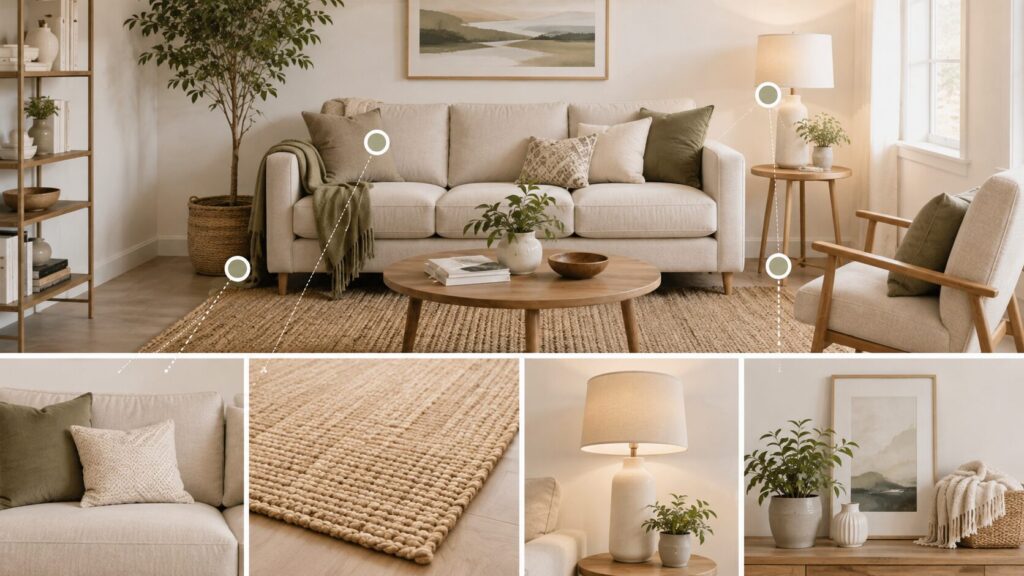
Where the Splurge-vs-Save Framework Comes Together
Applying the framework across a full small living room produces a spending pattern that looks roughly like this, assuming a moderate total budget:
Highest allocation: the sofa (35–45% of total budget) — this is where quality genuinely matters most and shows fastest if skipped.
Moderate allocation: the rug, properly sized (10–15% of total budget) — size matters more than price point here, so this allocation goes toward getting the size right rather than a premium material.
Lower allocation, high impact: lighting (5–10% of total budget) — disproportionately effective relative to its modest cost share.
Lowest allocation per item, but several items: textiles, wall decor, side tables, and plants collectively (remaining 30–40%) — this is where secondhand sourcing and budget retail genuinely perform as well as higher-priced alternatives, so the money goes further here than in any other category.
Quick Reference: Affordable Small Apartment Living Room Ideas by Priority
Splurge (relatively, within a budget):
- The sofa — solid frame, genuine cushion fill, durable fabric
- Rug size (not necessarily rug price) — go bigger before going nicer
Save without compromise:
- Lighting fixtures (bulb temperature matters more than fixture cost)
- Coffee and side tables (one tier above the absolute cheapest)
- Textiles — cushion covers, throws, curtains
- Wall decor and mirrors (thrift and secondhand-first category)
- Plants (propagate rather than buy multiples; one large plant over many small ones)
Best sourcing by category:
- Sofa: secondhand marketplaces, mid-range direct-to-consumer brands, or reupholstered vintage frames
- Rug: IKEA, Rugs USA sales, Ruggable for washable durability
- Tables: IKEA, Target, secondhand, nesting sets for better value
- Textiles: budget retailers (IKEA, Target, H&M Home, Amazon)
- Decor: thrift stores, estate sales, Etsy/Society6 for affordable large-format art
Conclusion
Affordable small apartment living room ideas work best as a spending strategy, not just a list of cheap products. Deciding in advance which categories deserve real investment — the sofa, primarily, and rug sizing — and which categories perform just as well at the lowest reasonable price point — lighting, textiles, wall decor, tables, plants — produces a room that looks considered rather than uniformly cheap or unevenly splurged.
The sofa earns the largest share of the budget because it’s the one piece that shows quality differences fastest and costs the most to replace if the initial purchase falls apart within a year or two. Nearly everything else in the room — lighting, textiles, side tables, wall decor, plants — performs remarkably well at budget price points, provided the sourcing is smart: secondhand for frames and furniture with good bones, budget retail for textiles and lighting components, and careful attention to sizing over price point for the rug specifically.
None of this requires an unlimited budget or compromises on how the finished room looks. It requires understanding which few decisions actually matter for quality and durability, and directing more of the available budget there — while shopping confidently and without guilt at the lowest reasonable price point for everything else.
Start with the sofa, since it anchors both the room’s function and its budget. Then move through the priority order — rug size, lighting, and finally the textiles and decor that bring the room’s personality into focus.
Frequently asked questions:
What should I spend the most money on when furnishing a small living room on a budget?
The sofa deserves the largest share of a living room budget — typically 35–45% of the total spend — because it gets the most daily physical use and shows quality differences (frame durability, cushion fill degradation, fabric wear) faster than any other item in the room. A genuinely cheap sofa frame or low-density foam cushion noticeably deteriorates within a year or two, which often means replacing it sooner than expected, making the initial “savings” a false economy. Nearly every other category in the room — lighting, textiles, side tables, wall decor — performs well at budget price points without the same durability concerns.
Where can I find affordable furniture for a small apartment living room?
For the sofa specifically, Facebook Marketplace and local secondhand sources frequently offer quality pieces (sometimes barely used) at a fraction of retail cost, while mid-range direct-to-consumer brands like Article or Burrow, or IKEA’s higher-tier sofa lines, deliver better construction than the very lowest price tier. For rugs, IKEA’s flatweave and jute lines and Rugs USA during sale periods offer good value. For tables, side pieces, mirrors, and frames, thrift stores and estate sales consistently deliver the best value-to-quality ratio, since these categories have a strong secondhand market and often carry significant retail markup relative to manufacturing cost.
How much does it cost to furnish a small living room on a budget?
A functional, well-put-together small living room on a tight budget — using secondhand sourcing for the sofa and larger pieces, budget retail for lighting and textiles — typically runs $400–$800 total for a room that’s genuinely being furnished from scratch. If existing furniture just needs updating and styling rather than full replacement, $150–$300 covers lighting, a properly sized rug, textiles, and decor. A moderate budget that includes a new (not secondhand) sofa alongside the other categories typically runs $800–$1,500, depending largely on the sofa’s price point, which is the single largest variable in the total.
Is it worth buying secondhand furniture for a small apartment?
Yes, particularly for sofas, side tables, frames, mirrors, and lamps. Secondhand furniture at these categories is often built to a higher original quality standard than equivalent new budget furniture, since manufacturing costs for genuinely low-price new furniture typically mean thinner materials (particleboard rather than solid wood, lower-density foam) than furniture made even a decade or two ago. The main categories where new purchases generally make more sense are textiles (rugs, curtains, bedding) for hygiene and wear reasons, and lighting components like bulbs, where secondhand doesn’t offer a meaningful advantage.
What’s the biggest mistake people make when decorating a small living room on a budget?
Spending the budget evenly across every category rather than concentrating more of it on the sofa and rug sizing while saving aggressively elsewhere. This produces a room where the sofa (the piece that gets the most use and shows wear fastest) is undersized in quality relative to its importance, while money that could have gone toward better structural furniture gets spread across decorative items that would have performed just as well at a lower price point. The fix is deciding in advance which one or two items in the room genuinely warrant more investment, then shopping confidently at the lowest reasonable price point for everything else.