
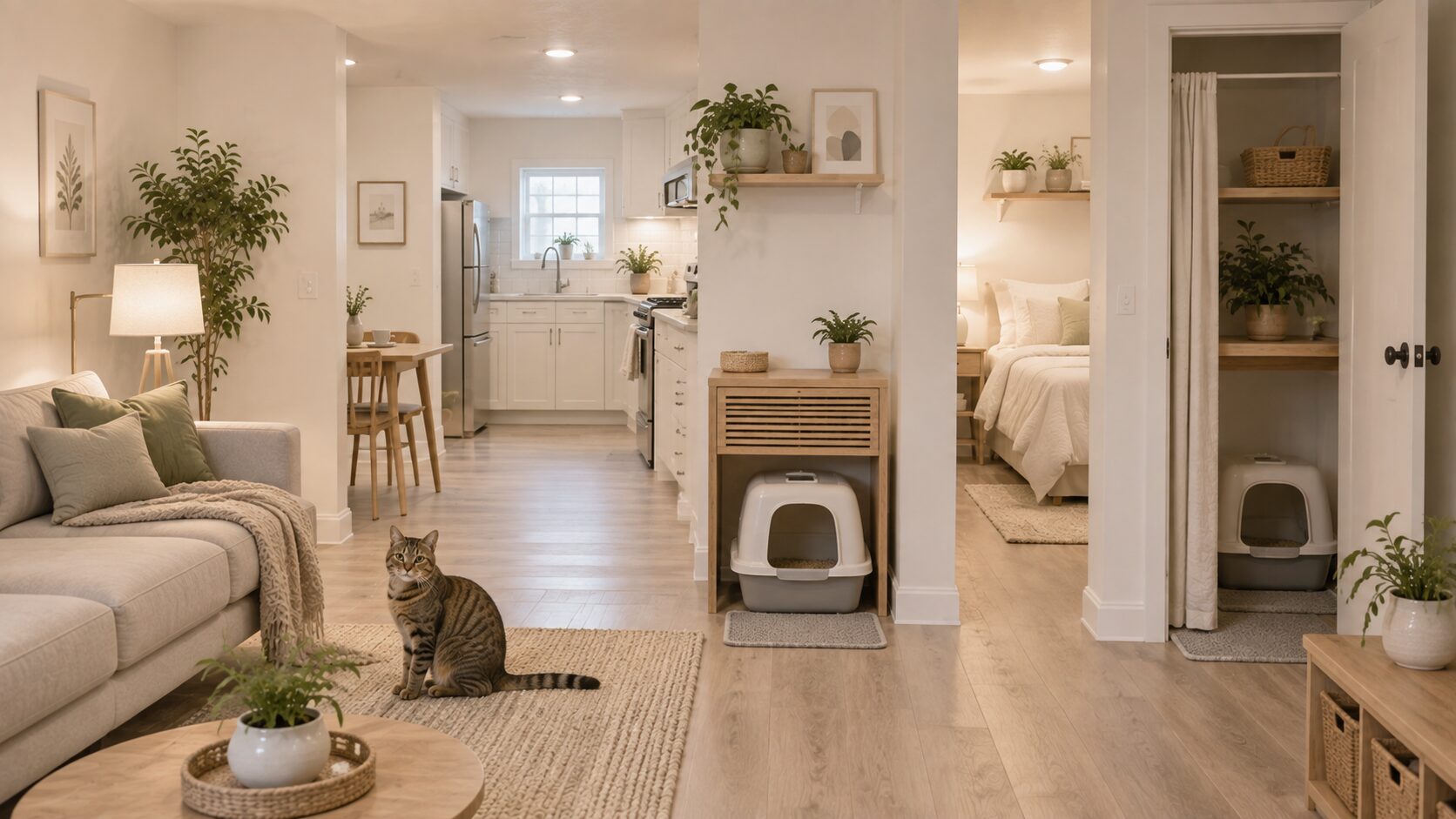
Where to Put a Cat Litter Box in a Small Apartment (Without Ruining the Room)
There’s no version of small apartment living that makes a litter box easy to hide. In a house, it goes in a spare bathroom, a basement corner, a mudroom — somewhere with a door that closes. In a studio or a one-bedroom, every square foot is visible from somewhere else, and the litter box needs a home regardless.
This is a genuinely common problem, and it comes with two competing pressures that pull in opposite directions. Your cat needs a litter box location that meets their actual behavioral needs — quiet, accessible, away from food, with enough space to move around in. You need a location that doesn’t dominate the room, doesn’t smell, and doesn’t feel like the apartment is designed around a litter box instead of the other way around.
The good news: these two needs aren’t actually as opposed as they first seem. The best litter box placements in small apartments tend to satisfy both — a location that works well for your cat’s comfort also tends to be one that’s easier to visually manage and keep odor-free.
This guide walks through the best places to put a litter box in a small apartment, room by room, along with the furniture solutions and odor management strategies that make the whole thing work in practice.
What Your Cat Actually Needs From a Litter Box Location
Before the specific placement ideas, it helps to understand what makes a location work for a cat — because placement decisions that ignore this often result in a cat that stops using the box reliably, which creates a much bigger apartment problem than an exposed litter box ever would.
Quiet and low-traffic. Cats generally prefer a location that isn’t in a busy walkway or right next to a loud appliance (a washing machine, a furnace, a frequently used door). A startling noise while using the box can create lasting hesitation about that location.
Not directly next to food and water. Cats instinctively prefer distance between where they eliminate and where they eat, which is a natural behavior rooted in avoiding contamination near a food source. Keep the litter box and the food bowls in different areas of the apartment where possible.
Easily accessible at all times. A box that’s hard to reach — behind a closed door that sometimes shuts, up or down stairs a cat finds difficult, or in a spot that requires navigating around furniture — can lead to accidents elsewhere in the apartment simply because the box wasn’t reliably available.
Enough space around the box for normal movement. Cats need room to turn around, dig, and position themselves comfortably. A box wedged into a space so tight the cat can barely enter and turn around discourages regular use.
Multiple boxes for multiple cats, plus one extra. Veterinary and behaviorist guidance generally recommends one litter box per cat, plus one additional box — so a two-cat household ideally has three box locations, even in a small apartment. This is one of the genuine constraints that makes small-space litter box planning harder with more than one cat.
Where to Put a Cat Litter Box in a Small Apartment: Room by Room
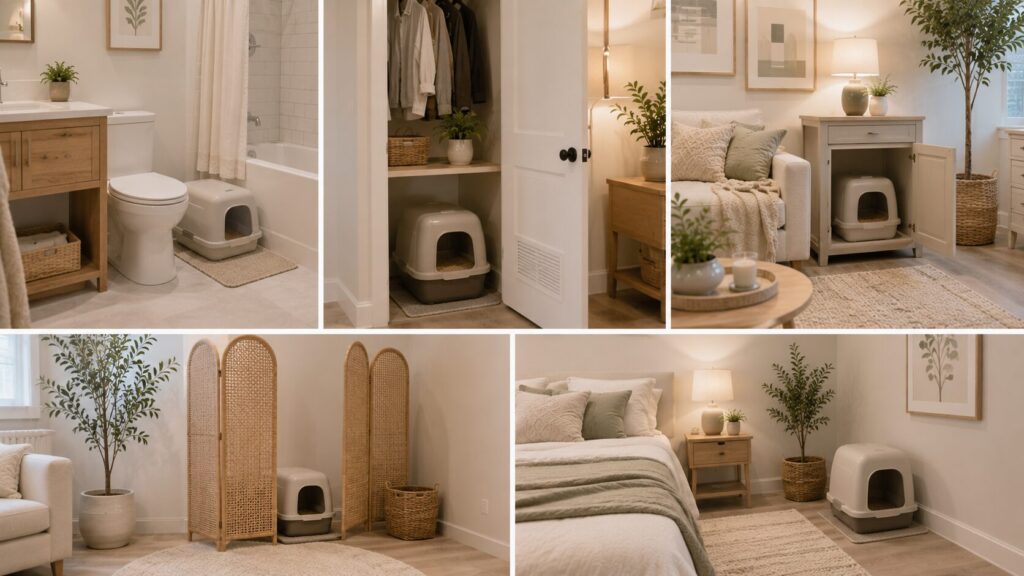
The Bathroom
For many small apartments, the bathroom is the most practical litter box location, and it’s worth starting here because it solves several problems simultaneously.
Why it works: Bathrooms typically have tile or vinyl flooring, which handles litter tracking and any spills far better than carpet. They’re usually a low-traffic area for most of the day. And the room already has a “utility” function, so a litter box doesn’t feel out of place the way it might in a living room.
Where specifically: Beside the tub, in a corner away from the toilet and sink traffic path, or — in bathrooms with enough space — tucked into a corner behind the door swing, where it’s out of the direct sightline when the door is open.
The trade-off to manage: A bathroom door that closes fully (rather than staying propped open) blocks access, so if the litter box lives in the bathroom, the door needs to stay open, cracked, or fitted with a cat door insert. This is worth deciding on deliberately rather than discovering the hard way when the cat can’t get in.
The Closet
A closet — a coat closet, a linen closet, or a section of a bedroom closet — provides a genuinely enclosed, visually hidden location, provided it’s set up correctly for airflow and access.
Why it works: Closets are visually out of the main living area entirely, which addresses the aesthetic concern directly. They also tend to be quiet, low-traffic spaces.
What it requires: A cat door cut into the closet door (or the door left permanently ajar) for reliable access, and — critically — some form of ventilation, since a fully enclosed closet with no airflow concentrates odor more than almost any other location. A small battery-operated fan, a vent cut into the door, or simply keeping the door cracked open rather than shut solves this.
Best for: Apartments with an underused closet — a coat closet rarely used for coats, a linen closet with more space than linens require. Converting even a portion of that space to a litter box station is one of the most visually effective hiding solutions available.
Behind Furniture or in a Furniture Piece Designed for It
Furniture specifically designed to conceal a litter box — cabinets with a cutout entrance, ottomans with a hidden compartment, or console tables built around a litter box footprint — solve the visibility problem directly, in any room of the apartment.
Why it works: These pieces function as normal furniture from the outside while housing the litter box entirely out of sight. A console table that also serves as an entryway surface, or a cabinet that doubles as a side table, means the litter box occupies space that’s already earning its place in the room for another reason.
What to look for: Adequate ventilation (avoid fully sealed designs with no airflow), an opening large enough for the cat to enter and turn around comfortably (this varies by cat size, but generally the opening and interior should accommodate a cat 1.5 times their body length), and easy access for cleaning — a design that requires disassembly to scoop the box daily will quickly become a maintenance burden nobody keeps up with.
Best for: Living rooms, bedrooms, or entryways where no closet or spare bathroom space is available, and where the litter box genuinely needs to double as furniture to make sense in the room.
A Dedicated Corner With a Visual Screen
For apartments without a suitable closet or enclosed furniture option, a corner of a room — the living room, bedroom, or even a kitchen corner far from food prep — screened with a simple room divider, a tall plant, or a decorative privacy screen, provides visual concealment without requiring a fully enclosed structure.
Why it works: This is often the most flexible and least expensive solution, and it avoids the airflow and access concerns that come with fully enclosed options. The litter box remains in an open room but visually separated from the main sightlines.
What to look for: A screen or divider tall enough to block sightlines from the room’s main seating or activity areas, positioned so the cat still has full, unobstructed access.
Best for: Studio apartments and open-plan spaces where there’s genuinely no separate room or closet available, and where flexibility matters more than complete concealment.
The Bedroom (With Caveats)
Placing a litter box in a bedroom corner works for some households, though it comes with more caveats than the other locations covered here.
Why it can work: Bedrooms are often quieter and lower-traffic than living rooms, which suits a cat’s preference for a calm location. For cats that are more anxious or easily startled by household activity, a bedroom placement sometimes results in more consistent box use than a busier room would.
The trade-offs: Odor management matters more here than almost anywhere else, since it’s the room where you sleep. A litter box in a bedroom requires more disciplined daily scooping and a genuinely effective odor control strategy (covered below) to avoid the room smelling noticeably of litter. Some people also find a litter box in the bedroom psychologically at odds with using that room purely for rest — a personal preference worth considering honestly before committing to this placement.
Best for: Single-cat households in smaller apartments where other rooms genuinely don’t have suitable space, provided a strong odor management routine is in place.
Furniture and Product Solutions for Small Apartment Litter Boxes
Litter Box Enclosure Furniture
As mentioned above, purpose-built furniture (litter box cabinets, benches, and consoles with a cutout entrance) has become a genuinely well-developed product category, with options across a range of styles and price points — from simple particleboard cabinets under $100 to more considered mid-century or Scandinavian-style pieces in the $200–$400 range that look like real furniture rather than a pet accessory.
The key functional features to prioritize regardless of style: a large enough interior for the litter box plus turning room, a removable or hinged top or side panel for easy daily scooping access, and some ventilation (a vented back panel or a gap that allows airflow) to prevent odor buildup inside an enclosed space.
Low-Profile and Corner-Specific Litter Boxes
For situations where full furniture concealment isn’t practical, choosing a litter box designed for the space itself — a corner-specific triangular box that fits a room corner more efficiently than a rectangular box, or a low-entry box for cats with mobility considerations — makes the exposed placement work better within a small footprint.
Litter Mats for Tracking Control
A litter mat positioned directly in front of the box entrance — regardless of where the box itself is placed — captures a significant portion of the litter that would otherwise track through the apartment on the cat’s paws. This matters more in a small apartment than a large one, since tracked litter is more likely to spread across a limited number of rooms rather than being contained to one distant area of a larger home.
Odor Control Strategies for Small Apartment Litter Boxes
Odor management matters more in a small apartment than almost any other single factor in litter box placement, because there’s simply less air volume to dilute any smell and less physical distance between the box and every other room.
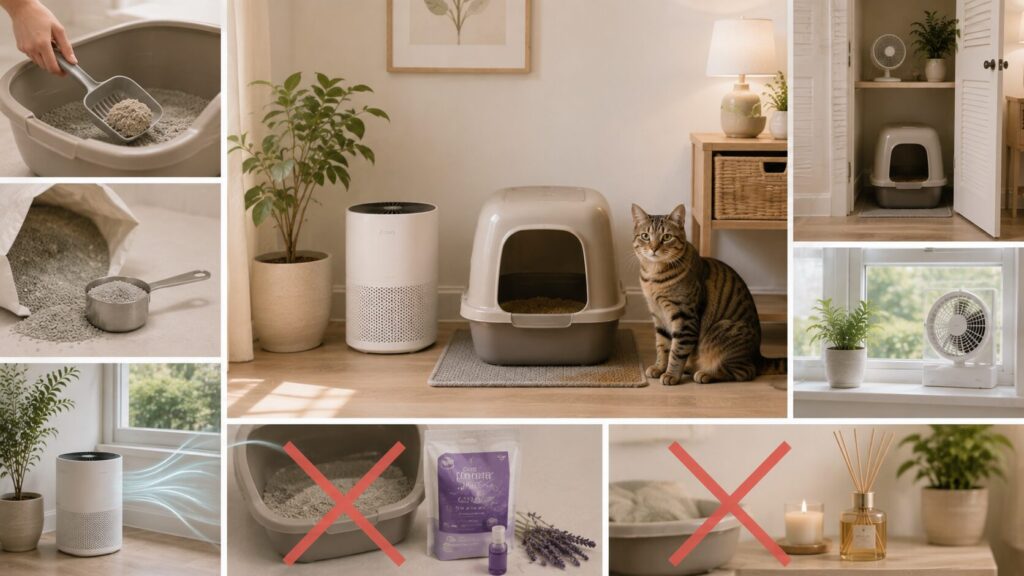
Scoop Daily, Without Exception
This is the single most effective odor control strategy available, and it costs nothing beyond a few minutes of daily attention. Waste left in the box even for a day noticeably increases odor in a way that’s disproportionate to the actual time elapsed, especially in a smaller apartment’s more limited air volume.
Choose an Odor-Control Litter Formula
Clumping litters formulated specifically for odor control (activated charcoal blends, or litters with baking soda integrated into the formula) genuinely outperform basic clay litter for smell management, and the price difference is generally modest relative to the improvement.
Add a Small Air Purifier Near the Litter Box Location
A compact air purifier with a carbon filter (specifically effective against odors, as opposed to purifiers optimized mainly for allergens and dust) positioned near the litter box location addresses ambient smell more directly than general room deodorizing.
Ventilate the Specific Area
Whether the box is in a closet, behind furniture, or in an open corner, some airflow — a cracked door, a small fan, proximity to a window that gets opened regularly — reduces the concentration of odor that builds up in a fully enclosed, unventilated space.
Avoid Scented Litter and Heavy Air Fresheners as the Primary Solution
Scented litters and strong air fresheners mask odor rather than addressing its source, and many cats actively dislike strongly scented litter, which can discourage box use and create the exact accidents-outside-the-box problem odor control is meant to prevent. Address the source (daily scooping, odor-control litter formula, ventilation) before relying on masking scents.
Multiple Cats in a Small Apartment: Managing More Than One Box
For households with more than one cat, the “one box per cat plus one” guideline creates real space challenges in a small apartment, but it’s worth honoring as closely as possible, since insufficient litter box availability is one of the most common causes of litter box avoidance and household accidents.
Distribute boxes across different rooms rather than clustering them together. Cats — especially in multi-cat households where dynamics between cats matter — often prefer boxes that aren’t positioned side by side, since a confident cat can effectively guard a cluster of boxes and prevent a more submissive cat from using any of them.
Use vertical or furniture-based solutions to fit more boxes into limited square footage. A bathroom box, a closet box, and a furniture-concealed box in three different rooms accomplishes the distribution goal without requiring three fully open floor spaces.
Monitor for signs that the current setup isn’t working — a cat avoiding the box, eliminating just outside it, or increased tension between cats near litter areas — and be willing to adjust placement based on what you observe rather than assuming the initial setup is permanent.
Quick Reference: Where to Put a Cat Litter Box in a Small Apartment
Best default options, in order of general suitability:
- Bathroom corner (tile flooring, low traffic, existing utility function)
- Underused closet with ventilation and reliable access
- Purpose-built concealment furniture (cabinet, bench, console)
- Screened corner in a living space (flexible, no structural requirement)
- Bedroom corner (works with strong odor management; more caveats)
Non-negotiable requirements regardless of location:
- Away from food and water bowls
- Quiet, low-traffic area, away from loud appliances
- Reliable access at all times (not behind a door that sometimes closes)
- Enough interior space for the cat to turn around comfortably
Odor control essentials:
- Daily scooping without exception
- Odor-control litter formula (activated charcoal or baking soda blend)
- Some ventilation for enclosed or furniture-based placements
- A carbon-filter air purifier near the location if odor remains a concern
For multiple cats:
- One box per cat, plus one additional box
- Distribute boxes across different rooms rather than clustering
- Watch for avoidance behavior and adjust placement if needed
Conclusion
Where to put a cat litter box in a small apartment comes down to balancing two sets of real needs — your cat’s behavioral requirements and your own need for a livable, presentable space — rather than treating them as opposing forces. In most small apartments, a bathroom corner, an underused closet, or a piece of concealment furniture satisfies both: quiet, accessible, and visually out of the main living area.
The placement itself matters less than getting the fundamentals right regardless of location: distance from food, reliable access, adequate space for the cat to move comfortably, and enough ventilation to prevent odor buildup in any enclosed spot. Daily scooping and a decent odor-control litter formula do more for how the apartment smells than almost any furniture or placement decision on their own.
For households with more than one cat, resist the temptation to cluster boxes together to save space — distributing them across different rooms, even in a small apartment, genuinely affects whether every cat reliably uses the boxes available.
Start with whichever location in your specific apartment layout best satisfies the core requirements — quiet, accessible, away from food — then layer in the concealment and odor management strategies that fit your space and budget. A well-placed litter box, maintained consistently, stops being something you have to work around and becomes just another functional part of a well-organized small apartment.
Frequently asked questions:
Can I put a litter box in the bathroom of a small apartment?
Yes, and for many small apartments, the bathroom is the most practical location. It typically has tile or vinyl flooring that handles litter tracking better than carpet, it’s usually a low-traffic area, and it already serves a utility function that makes a litter box feel less out of place than it might in a living room. The main consideration: the bathroom door needs to stay open, cracked, or fitted with a cat door insert, since a fully closed door blocks access — plan for this deliberately rather than discovering it’s a problem after the cat can’t get in.
How do I hide a litter box in a studio apartment with no separate rooms?
In a studio, purpose-built concealment furniture — a cabinet, bench, or console table with a cutout entrance for the litter box — is usually the most effective solution, since it functions as normal furniture while fully hiding the box inside. A screened corner (using a room divider, tall plant, or privacy screen) is a more flexible, lower-cost alternative that visually separates the box from the main living area without requiring enclosed furniture. Whichever option you choose, prioritize ventilation — a fully sealed enclosure with no airflow concentrates odor more than an open corner would, which becomes a bigger problem in a studio’s more limited air volume.
How many litter boxes do I need for multiple cats in a small apartment?
General veterinary and behaviorist guidance recommends one litter box per cat, plus one additional box — so two cats ideally have three box locations, even in a small apartment. This matters because insufficient litter box availability is one of the most common causes of litter box avoidance and household accidents. In a small apartment, distribute these boxes across different rooms rather than clustering them together, since a confident cat can effectively guard a cluster of nearby boxes and prevent a more submissive cat from using any of them — distribution matters as much as total count.
How do I keep my small apartment from smelling like a litter box?
Daily scooping without exception is the single most effective strategy and costs nothing beyond a few minutes of attention — waste left even one day noticeably increases odor, especially in a smaller apartment’s more limited air volume. Beyond that, an odor-control litter formula (activated charcoal or baking soda blends specifically) outperforms basic clay litter for smell management. Some ventilation for the litter box’s specific location — a cracked closet door, a vented furniture enclosure, proximity to a window — prevents odor from concentrating in an enclosed space. A compact air purifier with a carbon filter positioned near the litter box location addresses ambient smell more directly than general room deodorizing or scented products, which mask odor rather than solving it.
Is it bad to put a litter box in the bedroom?
It’s not inherently bad, but it comes with more considerations than other locations. Bedrooms are often quiet and low-traffic, which some cats — particularly more anxious ones — respond well to, sometimes resulting in more consistent box use than a busier room would provide. The trade-off is that odor management becomes more critical, since it’s the room where you sleep, requiring more disciplined daily scooping and an effective odor-control strategy than a placement further from where you spend passive time. Whether it’s the right choice ultimately depends on your specific apartment’s other available spaces and your own comfort with the arrangement — for single-cat households in genuinely space-limited apartments where other rooms don’t offer suitable alternatives, a well-maintained bedroom placement can work.