7 Tips on How to Decorate an Outdated Apartment (Without Breaking Your Lease)
Popcorn ceilings. Brass fixtures from 1987. Carpeting in a shade that has no official name but might be called “landlord beige.” If you’re renting an older apartment, you know the feeling — you didn’t choose any of it, you can’t change most of it, and yet you’re expected to live here and call it home.
The tension between “I want this place to feel like mine” and “I can’t paint, drill, or permanently alter anything” is one of the most common decorating challenges renters face. And it gets more complicated when the apartment isn’t just generic — it’s actively dated. The fixtures, the finishes, the layout choices all reflect an aesthetic that peaked decades ago and never quite moved on.
Here’s the thing, though: an outdated apartment is a design constraint, not a death sentence. Designers work with constraints all the time. The question isn’t “how do I make this look like a new apartment?” It’s “how do I decorate around what I can’t change so well that people stop noticing the things I can’t change?”
These 7 tips on how to decorate an outdated apartment answer that question practically and specifically — no irreversible changes, no voided security deposits, just approaches that actually work within the reality of renting a place that’s seen better decades.
Why Outdated Apartments Are Actually Easier to Decorate Than They Look
Before the tips, a reframe worth having.
Outdated apartments often have things going for them that newer builds don’t: higher ceilings, more substantial trim work, larger rooms, wood floors under that carpet, original architectural details that were once considered standard and are now considered charming.
The dated elements — the brass, the oak cabinets, the mauve tile — aren’t automatically problems. They become problems when the decor fights them. When the decor works with them — or deliberately contrasts them in a considered way — what felt dated starts reading as vintage, eclectic, or even intentional.
The goal isn’t to pretend the apartment is something it isn’t. It’s to add enough of your own aesthetic that the apartment’s existing personality becomes a backdrop rather than the whole story.
That’s the mindset. Now the practical steps.
Tip 1: Work With the Colours You Can’t Change, Not Against Them
Outdated apartments usually have at least one color problem: beige walls that came from a paint brand that stopped making it in 2003, oak cabinets the color of honey in the kitchen, mauve tile in the bathroom, green carpet someone made a decision about and then moved out.
The instinct is to try to neutralize everything around these colors — bringing in cool grays and whites to counteract the warmth. This almost always backfires. The mismatch between the warm dated elements and the cool modern additions creates a visual tension that makes both look worse.
A more effective approach: lean into the warm undertones rather than fighting them.
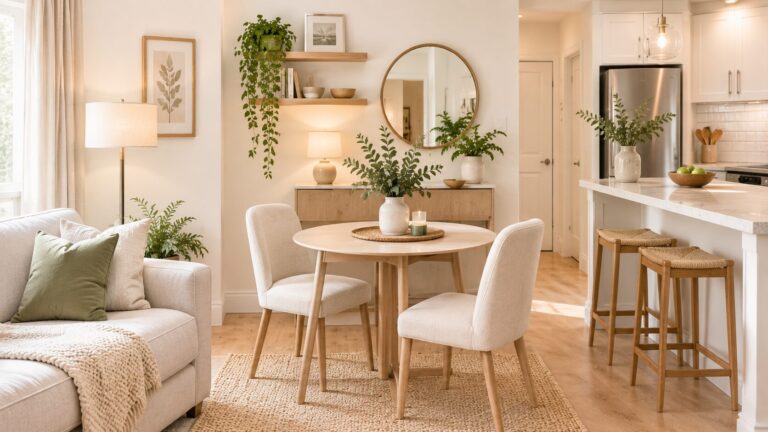
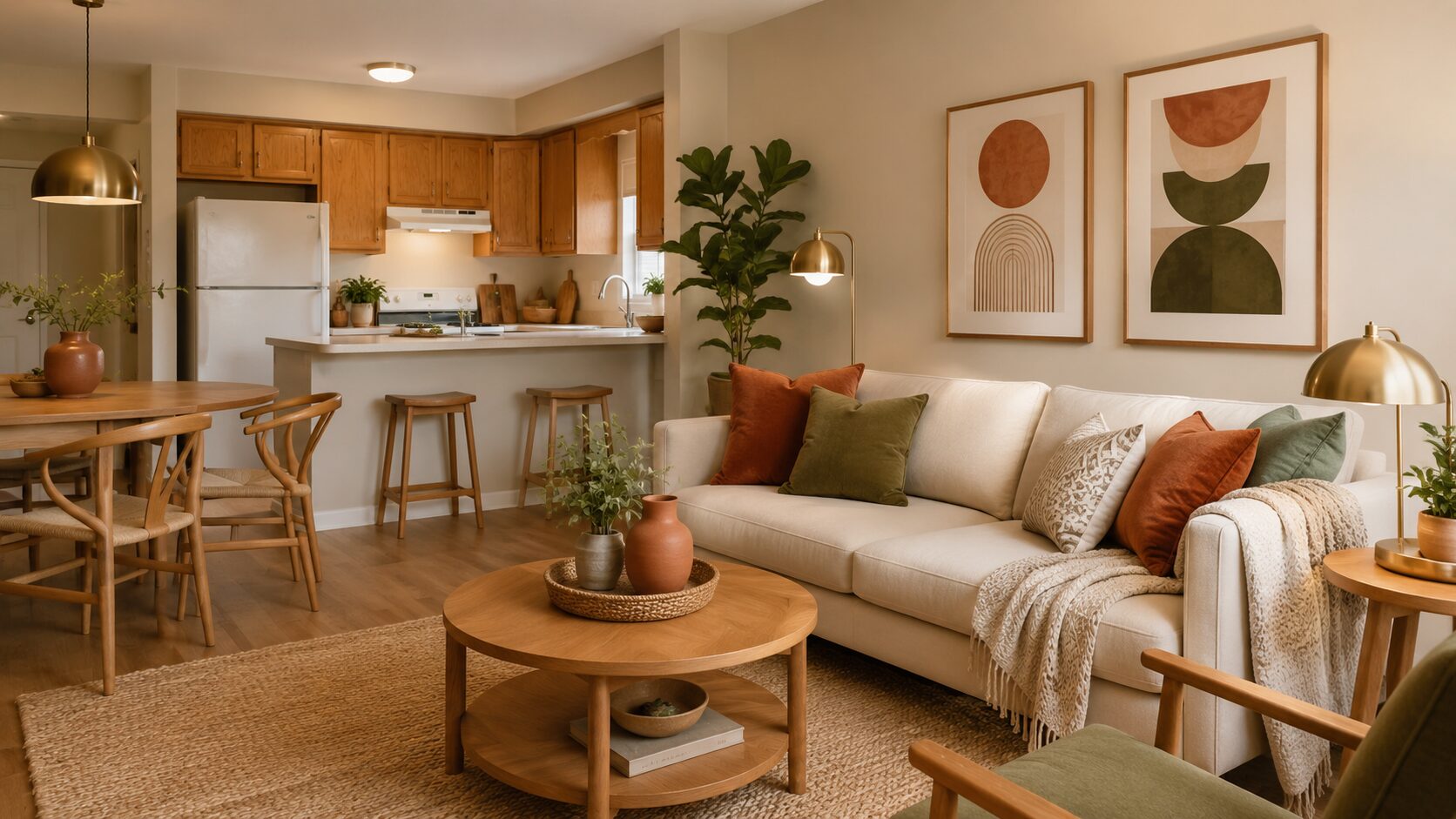
If the apartment has warm honey-oak tones throughout, bring in other warm elements — terracotta accents, rust-colored cushions, warm brass (which has been having a genuine design revival and suddenly looks intentional rather than dated), deep olive greens, and warm whites rather than cool ones. These create harmony with what’s already there rather than a battle.
The result is a room that feels cohesive. The oak doesn’t look like something that needs to be replaced — it looks like part of a warm, earthy palette that was deliberately chosen.
What to Do With Beige Walls
If the walls are a flat, lifeless beige — and most older apartment walls are — you have more options than you might think even without painting.
Removable wallpaper has improved dramatically in recent years. Modern peel-and-stick versions go on cleanly, come off without residue, and are available in genuinely good-looking patterns — linen textures, subtle botanicals, geometric prints, even convincing grasscloth looks. One wallpapered wall transforms a beige room.
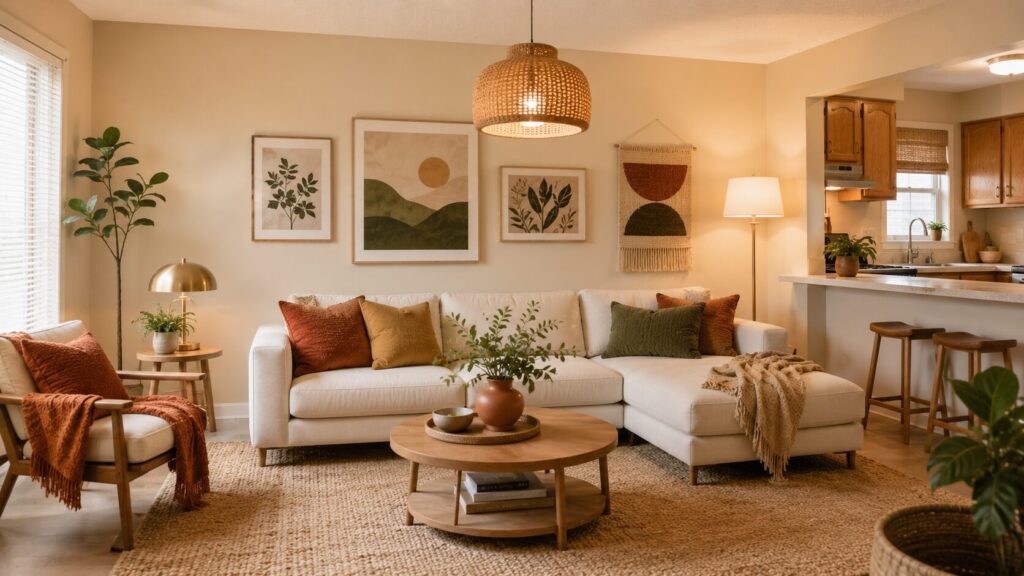
Large-scale art and textiles pull the eye away from the walls. If the walls are mediocre, stop letting them be the dominant visual element. A large piece of art, a gallery wall arrangement, or a textile piece like a woven wall hanging redirects attention and provides the color and texture the wall itself isn’t delivering.
Strategic lighting changes how wall color reads. Beige walls under warm bulbs look significantly better than beige walls under cool fluorescent light. Swapping overhead fixtures to warm LED bulbs (2700K is the right temperature for a home environment) makes the whole apartment feel warmer without touching the walls at all.
Tip 2: Replace What You’re Allowed to Replace — and Keep the Originals
Most leases don’t prohibit temporary hardware swaps. Landlords require that you return the apartment to its original condition when you leave — not that you live with every original fixture for the duration of your tenancy.
This opens up more room to work than most renters realize.
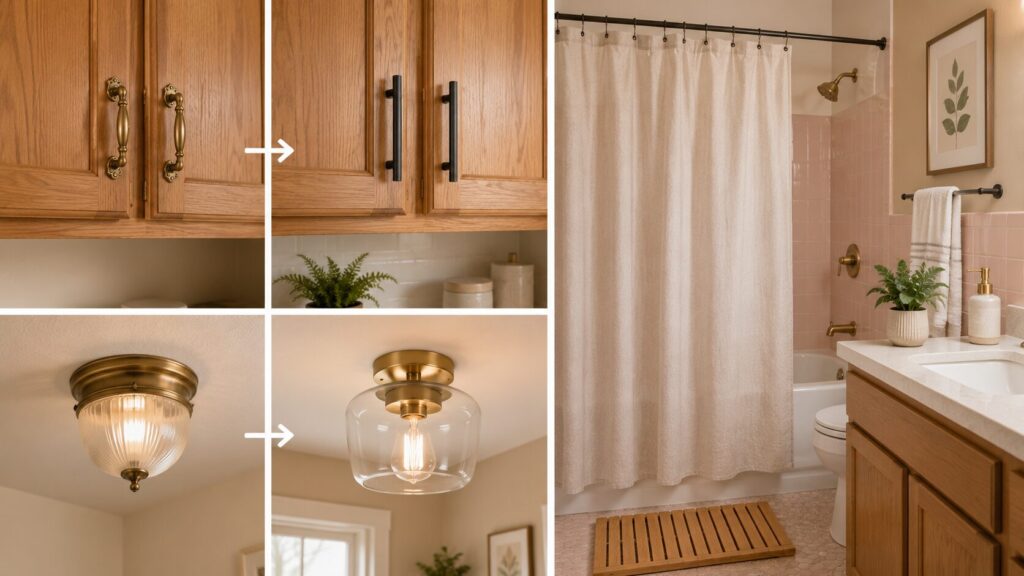
Cabinet hardware is one of the highest-impact, lowest-cost changes possible in an outdated apartment. Replacing dated brass or plastic cabinet pulls in the kitchen and bathroom with simple brushed nickel, matte black, or even updated brass hardware takes under an hour, costs $50–$150 total, and modernizes those spaces more dramatically than almost any other single change. Keep the original hardware in a labeled bag so you can reinstall it when you move out.
Light fixture swaps are similarly impactful. A dated ceiling medallion with a frosted globe pendant, a basic bathroom vanity strip, or a builder-grade ceiling fan can often be swapped with more current fixtures by anyone comfortable with basic electrical work (always turn off the breaker first). Store the originals and reinstall before moving. Even just replacing the light bulbs in existing fixtures from cool white to warm white makes a visible difference to how the apartment feels.
Shower curtain and bathroom accessories completely change the feel of a dated bathroom. A linen shower curtain, modern black or brushed brass hooks, a simple wooden bath mat, and matching soap dispensers are all removable and together transform a mauve-tiled bathroom into something that feels deliberately curated rather than frozen in time.
Tip 3: Use Rugs to Solve the Flooring Problem
Old apartment flooring is often the hardest single element to work around. Carpet in questionable condition. Vinyl tile in a pattern that hasn’t aged well. Scratched laminate. Or occasionally — if you’re lucky — hardwood floors under carpet that could be beautiful if the landlord ever bothered to look.
You can’t replace rental flooring. But you can cover it.
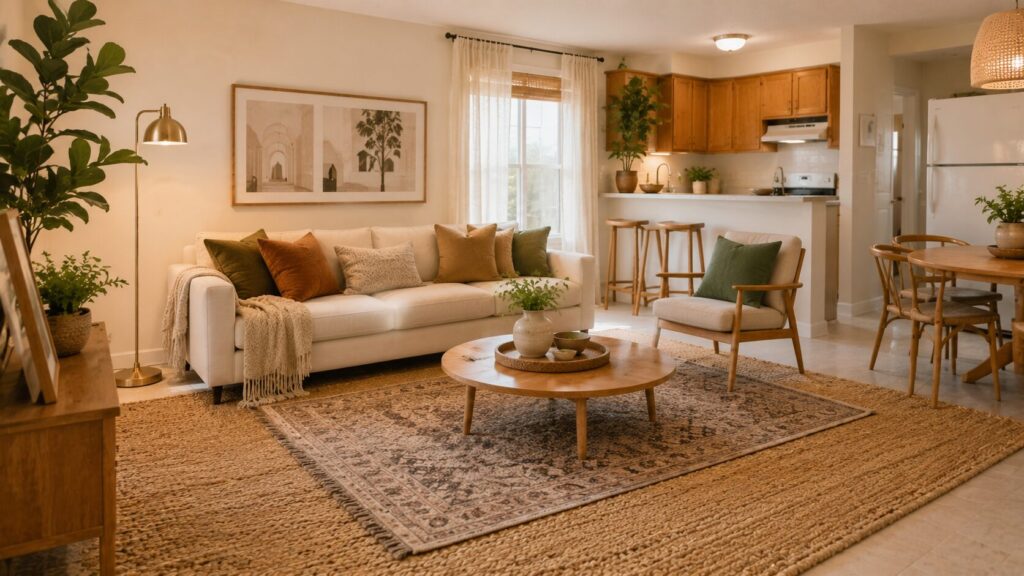
Area rugs are the most powerful tool in an outdated apartment’s decorating arsenal. A large rug layered over dated carpet resets the visual baseline of the room. The eye lands on the rug — its texture, color, and pattern — rather than what’s underneath. In a small apartment, a rug that anchors the main living area is more visually dominant than any other element in the room.
For carpeted spaces: look for rugs with enough weight and texture that they sit flat and don’t slip on the carpet underneath. Natural fibers like jute and wool work well in this context because their texture and weight hold them in place. A rug pad specifically designed for carpet-over-carpet use prevents shifting.
For dated vinyl or laminate: almost any rug works because it’s on a hard, flat surface. In this case, choose the rug you love most for its appearance rather than its functional properties — the floor underneath gives you more options.
The Layered Rug Approach for Small Apartments
In a studio or open-plan small apartment with dated flooring throughout, layering two rugs creates zones and visual interest that one rug can’t. A large, simple jute or sisal base rug covers the majority of the floor; a smaller, more visually interesting rug layered on top creates the focal point. This approach photographs beautifully, which is part of why it’s become common in design-forward small apartment decoration.
Tip 4: Bring In Plants — More Than You Think You Need
This sounds predictable, but the logic behind it is specific and worth explaining.
Outdated apartments often lack the clean lines and modern finishes that make contemporary interiors feel fresh. What they tend to have is space — more generous proportions in some cases than newer builds. Plants fill vertical and horizontal space with something that has no relationship to any era of design. A fiddle-leaf fig or a large monstera in a corner doesn’t look dated or modern — it just looks alive.
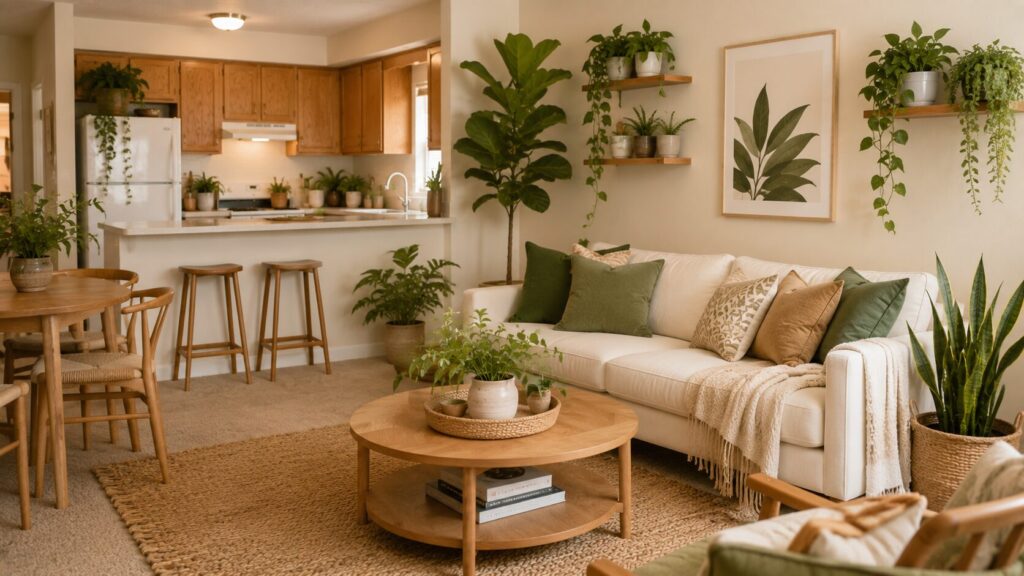
More importantly, plants pull the eye toward themselves rather than toward the walls, floors, or fixtures you can’t change. Put a large plant in the corner where the carpet meets the baseboards. Put smaller plants on the kitchen counter where they draw attention away from the cabinet style beneath them. Put trailing plants on high shelves where they cascade down a wall that would otherwise just be beige.
Plants also add texture and color that behaves differently from fabric or paint — it’s organic, varied, and visually complex in a way that printed textiles and flat paint can’t replicate.
For low-light older apartments: pothos, ZZ plants, snake plants, and heartleaf philodendrons are the most tolerant of the dimmer light common in older buildings with smaller windows. They’re also genuinely hard to kill, which matters in a decorated space where a dead plant would undermine the whole effect.
Tip 5: Layer Textiles to Add Warmth and Modernity Together
An outdated apartment typically has no textiles of its own — bare walls, hard floors (or bare carpet), and the basic furniture of whoever moved in. Textiles are the fastest way to add both warmth and a current aesthetic layer that floats on top of whatever the apartment’s bones look like.
In a small apartment especially, the textile choices — cushions, throws, curtains, bed linens — are often more visible than the walls because they’re at eye level and in the primary sightlines.
Curtains: The Single Most Transformative Textile
Curtains deserve their own mention because the impact of getting them right is so significant.
Outdated apartments often have either no curtains (just blinds), thin short curtains that hang at window height, or drapes in a dated fabric. None of these serve the room well.
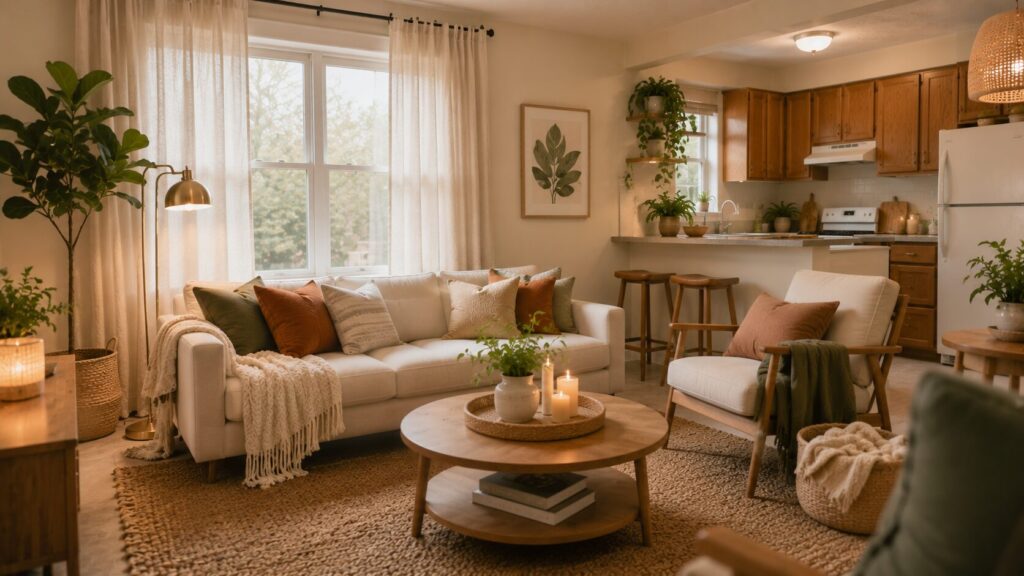
Floor-length curtains hung close to the ceiling — regardless of how high the window actually is — are one of the most reliably effective decorating decisions in any apartment, outdated or not. The vertical fall from ceiling to floor makes the room feel taller. The pooling of fabric at the bottom adds a layer of texture and softness. And good curtain fabric, even at a modest price, looks intentional in a way that cheap mini-blinds never do.
For older apartments with warm tones: linen curtains in off-white, warm ivory, or a muted natural color work in almost any space and never fight with existing finishes. They also get better-looking as they soften and drape with use.
Cushions and Throws as Palette Control
The sofa and bed are the largest colored surfaces you bring into a rental apartment. The cushions and throw on those pieces are where you communicate your actual aesthetic — because you chose them, unlike everything else in the space.
In a small outdated apartment, keeping the large upholstered pieces in neutral tones (so they don’t fight the dated finishes) and using cushions and throws for color and pattern gives you control over the room’s palette without permanent investment. When the aesthetic feels dated, you swap a few cushion covers rather than furniture.
Tip 6: Decorate An Apartment With Lighting That Does the Heavy Lifting
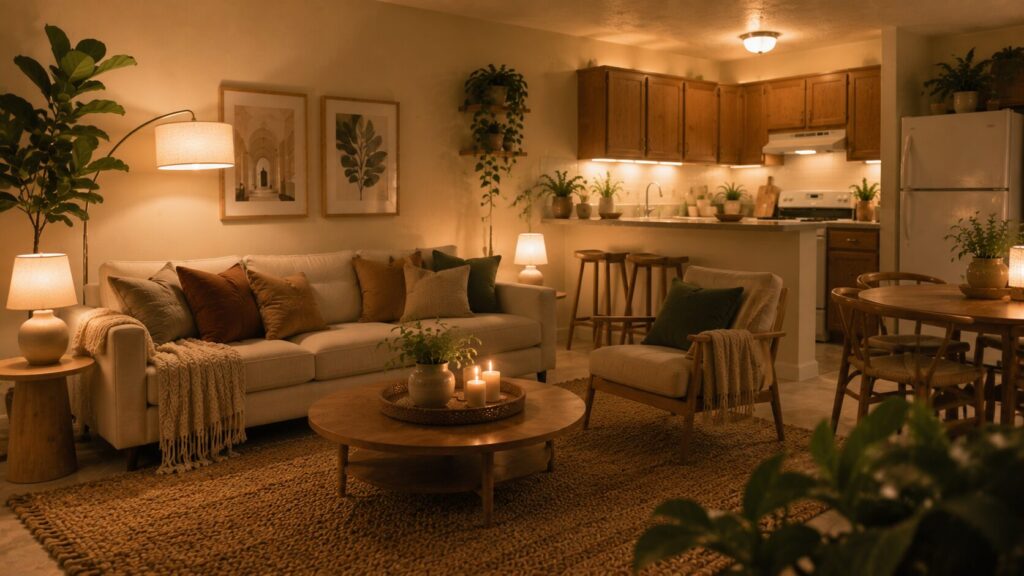
Older apartments often have one overhead light per room — a ceiling fixture that casts flat, even, slightly harsh light across the entire space. This kind of lighting does nothing for the room’s atmosphere and tends to make every dated element more visible rather than less.
Layered lighting transforms this.
The formula: ambient (the overhead), task (a lamp for reading or working), and accent (something that lights an object, a corner, or a shelf). With all three operating at once, the room has depth, warmth, and visual interest that a single overhead fixture simply can’t produce.
Lamps as Decor and Light Source
In a small outdated apartment, a well-chosen floor lamp in a corner serves two functions: it provides warm, indirect light that fills the room from a lower angle, and it provides a piece of furniture-level decor that contributes to the room’s aesthetic. A sculptural arc floor lamp, a rattan floor lamp, or even a simple drum-shade lamp in a good material changes the room’s character more than most renters expect from a lamp.
Table lamps on nightstands and side tables do the same work at a smaller scale — they add warm pools of light that the overhead fixture misses and provide decorative interest at eye level when you’re seated.
Under-Cabinet Lighting in the Kitchen
Many older apartment kitchens have no under-cabinet lighting, which leaves the counter in shadow when the overhead is on. Plug-in LED strip lights or battery-operated puck lights mounted under the upper cabinets add task lighting where you actually work and create a warm ambient glow that makes the kitchen feel significantly more pleasant — and more current.
Removable adhesive mounting means no damage. The lights take 20 minutes to install and are completely reversible.
Tip 7: Make It Personal Enough That the Apartment Reads as Yours
The final layer of decorating an outdated apartment is the most personal and the hardest to prescribe specifically — because it’s about you.
A well-furnished rental apartment with the right rug, good curtains, updated hardware, and layered lighting still won’t feel like home if it has no personality. The art on the walls, the books on the shelf, the objects on the side table, the plants you chose and named — these are what make a space feel inhabited by someone specific rather than staged for a listing.
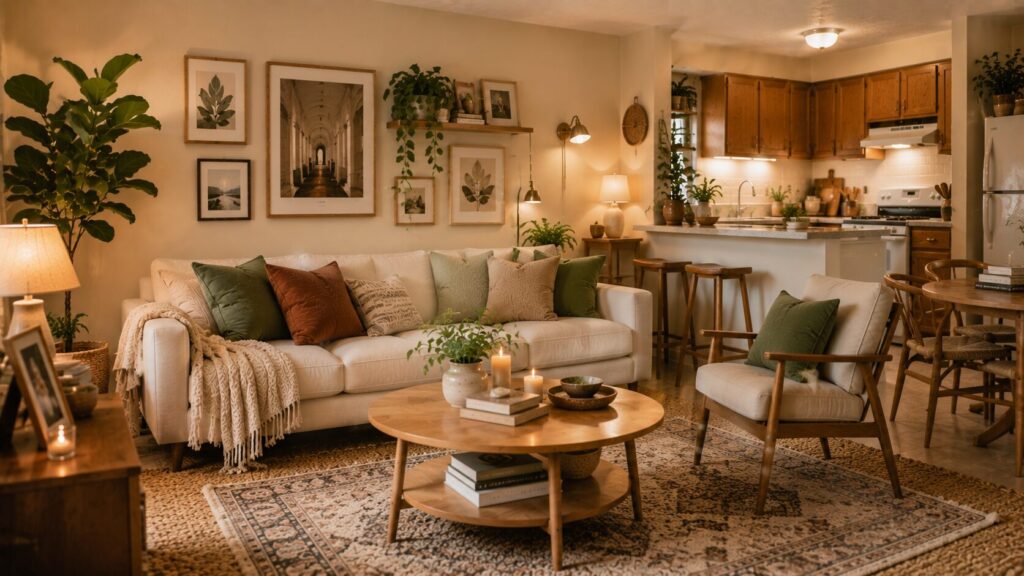
Art is the most direct expression of this. In a rental where you can’t paint, art becomes the color on the walls. Leaned art — frames resting on a shelf, a console, or directly on the floor against a wall — avoids the need for nails or damage. Command strips handle lighter pieces on walls (3M’s damage-free strips hold up to 16 pounds per pack, enough for most framed prints). A gallery wall arrangement handles many smaller pieces in a way that’s visually rich and personally expressive.
Books, displayed objects, and personal collections add the layer of specificity that makes a room feel inhabited rather than decorated. A shelf that holds books you’ve read, objects collected from places you’ve been, and a few well-chosen decorative pieces tells a more interesting story than a shelf arranged for symmetry alone.
The paradox of decorating an outdated apartment is that personal elements do more work than design-forward ones. The aged fixtures and finishes become part of the backdrop — context for the person who lives there — rather than the dominant story of the room.
Practical Takeaways: At a Glance
Color strategy:
- Work with warm undertones, not against them
- Removable peel-and-stick wallpaper for one statement wall
- Swap cool overhead bulbs for warm white (2700K) throughout
Reversible swaps:
- Cabinet hardware (store originals for move-out)
- Light fixtures (store originals, turn off breaker first)
- Shower curtain, hooks, and bathroom accessories
Flooring:
- Large area rug to cover and visually reset dated flooring
- Layered rug approach for small apartments or studios
- Carpet-to-carpet rug pad to prevent shifting
Plants and textiles:
- Large plants in corners to redirect visual attention
- Floor-to-ceiling curtains hung as high as possible
- Cushions and throws as primary palette control
Lighting:
- Floor lamp + table lamps to layer beyond overhead lighting
- Under-cabinet LED strips in kitchen (plug-in or battery)
- Warm bulbs (2700K) throughout for cohesive atmosphere
Personalization:
- Leaned or Command Strip-mounted art to avoid nail damage
- Books, collected objects, and personal pieces on open shelves
- Let the dated backdrop become context, not competition
Conclusion
An outdated apartment and a home that feels like yours are not mutually exclusive. They’re just two layers of the same space — and the job of decorating is to make the second layer interesting enough that the first one stops mattering.
The 7 tips in this guide work together toward that outcome. Getting the color strategy right means the dated finishes stop being eyesores and start being context. Removable hardware swaps make the kitchen and bathroom feel current without a renovation. The right rug resets the flooring. Curtains, textiles, and plants add warmth and life. Lighting layers depth into a space that would otherwise feel flat. And enough personalization makes the whole thing feel specifically, unmistakably like yours.
None of this requires a large budget, a cooperative landlord, or permanent changes. It requires intention — deciding what you want the space to feel like, then making deliberate choices that move it toward that feeling rather than just filling it with furniture.
Start with whichever tip addresses the element that bothers you most. That quick win usually creates enough momentum for the next change, and then the next. Before long, the apartment that felt impossible to decorate becomes the place you’re genuinely happy to come home to.
Frequently Asked Questions (FAQs.):
How do I update an apartment I can’t paint?
Removable peel-and-stick wallpaper is the most impactful paint-free wall update — modern versions come off without residue and are available in genuinely good-looking patterns. Large-scale art (leaned or hung with Command strips) adds the color the walls aren’t providing. Swapping overhead bulbs to warm white (2700K) changes the entire atmosphere of the space without touching the walls. Floor-length curtains hung close to the ceiling add color and texture at the room’s edges. And furniture and rug choices carry more visual weight than wall color in most furnished rooms — so the walls matter less than they seem to.
What should I do about dated kitchen cabinets in a rental?
The two highest-impact changes that don’t touch the cabinets themselves are: replacing the hardware (pulls and knobs) and decluttering the counters. New hardware in a matte black, brushed nickel, or updated brass finish modernizes oak or dated cabinets more dramatically than almost any other single change — swap the originals back in before moving. Clearing the countertops of everything except what’s actively used makes the kitchen feel significantly larger and cleaner. For the cabinet color itself: peel-and-stick contact paper in a solid or subtle wood grain is a reversible surface cover that transforms cabinet fronts with mixed but sometimes impressive results, and removes cleanly if applied carefully.
How do I make a small apartment feel less dated and more modern?
Focus on the elements you control: textiles, lighting, art, plants, and accessories. Modern linen curtains hung ceiling-to-floor, a large area rug in a current color or material, layered lighting from multiple sources (floor lamp, table lamps, under-cabinet strips), and plants throughout create a layer of current aesthetic that floats on top of the dated finishes. Warm bulb temperature throughout the apartment makes everything look better. Minimizing clutter reduces the visual complexity that makes small spaces feel cramped and dated simultaneously. The goal is to make what you add interesting enough that the original finishes become background rather than the dominant story.
Can I use peel-and-stick wallpaper in a rental apartment?
Yes, with some precautions. Modern peel-and-stick wallpaper (also called removable wallpaper) is designed to come off without damaging walls, and most landlords don’t consider it a lease violation since it’s fully reversible. The main risks are: applying it to freshly painted walls (wait at least 30 days after painting for the paint to fully cure before applying), applying it to textured walls (it adheres best to smooth surfaces), and leaving it on too long in high-humidity areas like bathrooms. Always test a small section in an inconspicuous spot before wallpapering a full wall, and follow the manufacturer’s removal instructions when it comes time to take it down.
What’s the most affordable way to decorate an outdated rental apartment?
The highest-impact, lowest-cost changes in order: swap the light bulbs to warm white throughout ($15–$30 total), replace cabinet hardware in the kitchen and bathroom ($50–$150), add a large area rug to the main living area (can be found affordably at discount home stores or secondhand), hang floor-length curtains ceiling-to-ceiling on the main windows (IKEA and Amazon carry inexpensive linen options), and add plants starting with low-maintenance varieties like pothos or snake plants. These five changes together cost well under $300 and transform the feel of an outdated apartment more than most larger-budget interventions. Secondhand furniture and art from thrift stores extend the impact further for minimal additional spend.